Palpation screening
Slow mapping with palms: where the wall feels guarded, where breathing stalls, where pain feels unexplained — those spots may require medical review instead of deeper pressure.
Slow, deep work on the anterior abdominal wall and diaphragm: warmth, easier belly breathing, less braced midsection tension — without promises to reposition organs or cure GI disease with massage alone.
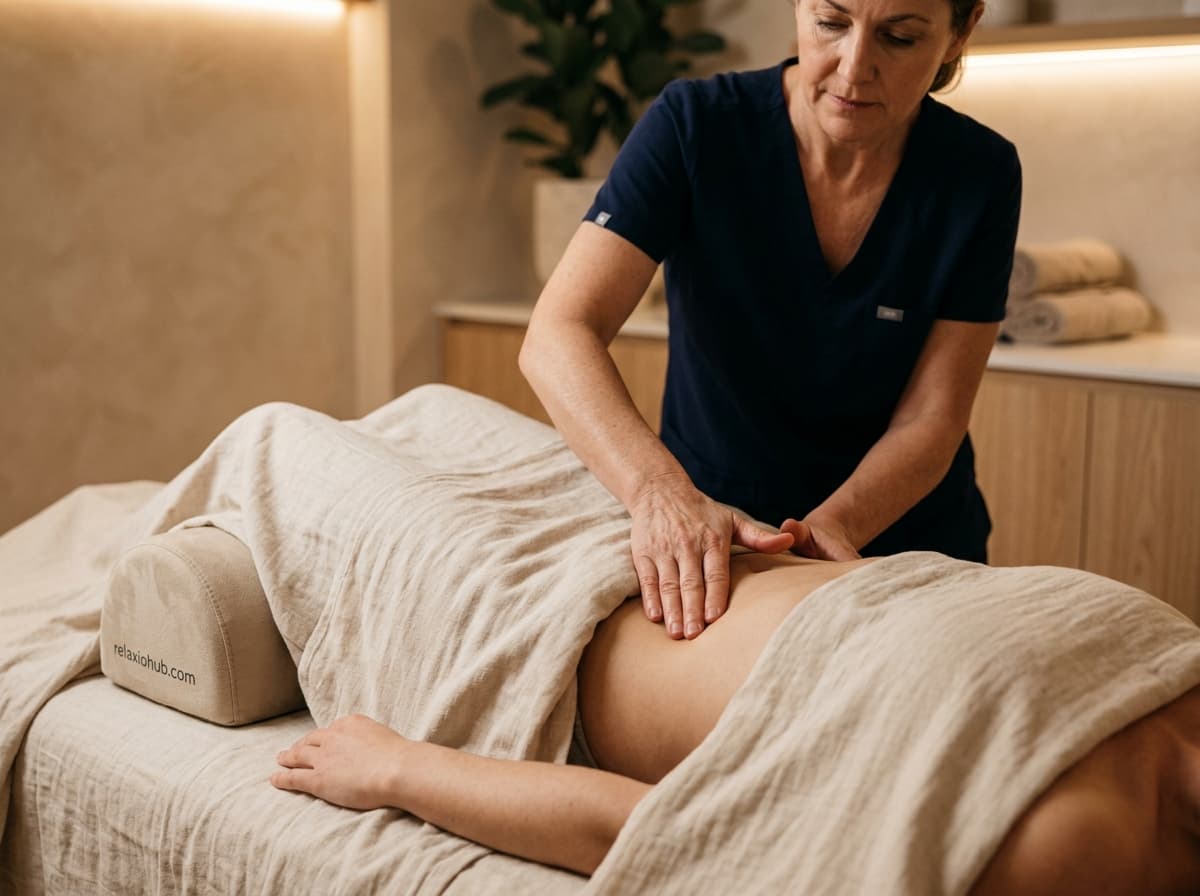
Working with depth
The name often promises internal magic. In studio practice, the mechanics are straightforward: contact stays on the anterior abdominal wall and breathing support — slow pressure, exhale sync, and pauses so the core can down-regulate instead of bracing.
This is not clinical visceral manipulation, not imaging, and not a licensed medical protocol. A studio therapist does not move organs from the inside and is not a substitute for a gastroenterologist during ulcer flares, IBS crises with sharp pain, or any illness with fever. Anatomically, the work addresses the anterior abdominal wall — rectus abdominis, transversus abdominis, external and internal obliques — along with the diaphragm and the solar plexus area. These are the layers the therapist works through the skin, without going inside.
Compared with a simple belly relaxation massage that uses light clockwise circles, studio visceral work typically runs longer, reaches deeper with breath-synchronized pressure, and gives more attention to the diaphragm and flanks. The safety contract is the same for both: you control depth with words, any acute symptom stops the session, and neither format replaces a clinician.
Clients who choose this format usually expect a more noticeable response in the diaphragm, flanks, and midsection after desk stress or prolonged tension. Outcomes remain subjective and individual.
At a glance
Technique
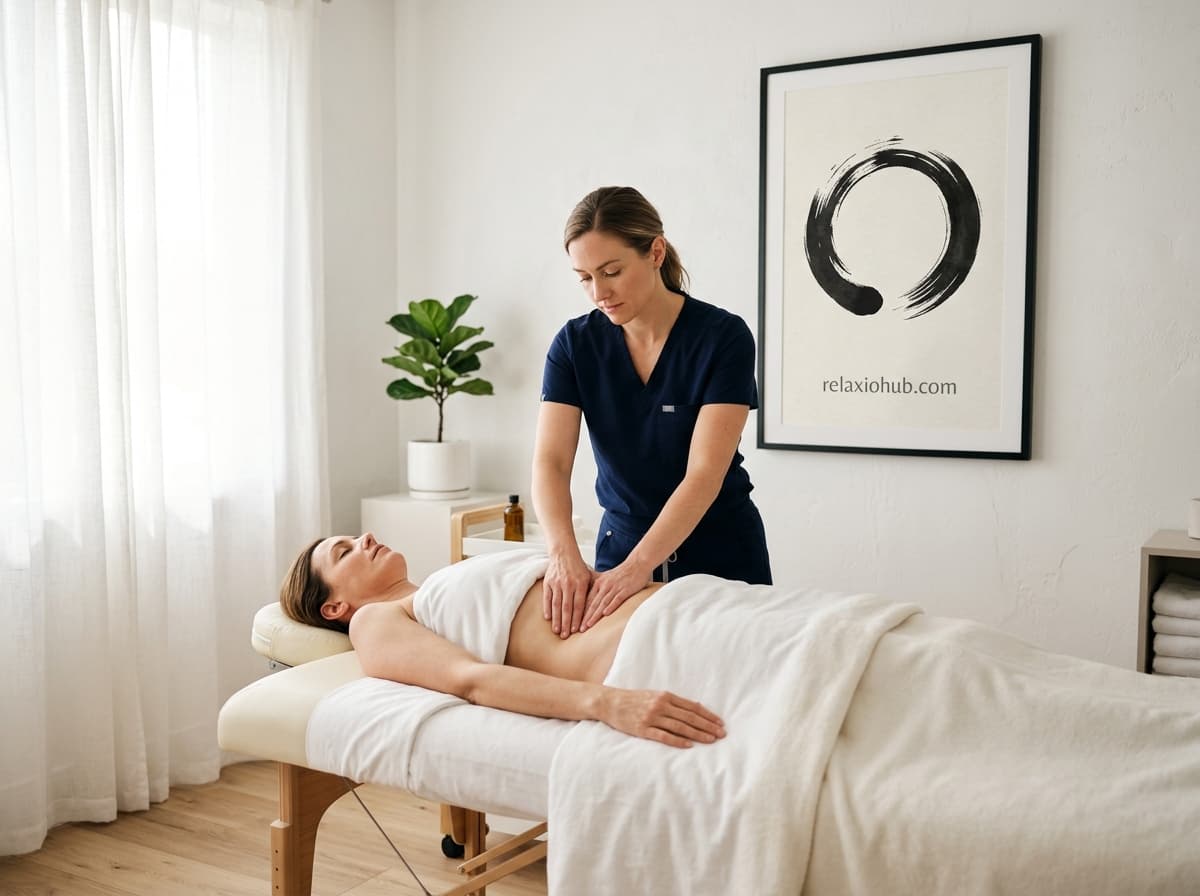
Studio visceral-style work stays on the abdominal wall: the therapist follows your exhale and your words — not a pain contest.
Slow mapping with palms: where the wall feels guarded, where breathing stalls, where pain feels unexplained — those spots may require medical review instead of deeper pressure.
Gentle contacts under the rib line restore full belly breathing and soften upper abdominal bracing that builds during long hours of chest-only breathing.
Steady pressure on the rectus and transversus abdominis lines — still external tissue work on the exhale, without sudden digging or unannounced depth changes.
A grounded rhythm many clients describe as warmth and relief after desk tightness — without unproven detox storytelling.
Light vibratory techniques to support circulation after the deep-pressure phase.
Benefits
Typical subjective outcomes after a course — without promising to treat diagnosed disease:
When the protective grip of the anterior wall releases and the diaphragm moves more freely, many clients describe the midsection as lighter and breathing as deeper.
Some people feel a quieter midsection or more natural gas passage after sessions — highly individual, and not positioned as IBS or constipation treatment.
The solar plexus area and diaphragm often hold emotional bracing. Slow manual work on these layers sends the nervous system a safety signal rather than a threat response.
Releasing the front abdominal wall frequently results in reflex easing of lower back tension — the anterior and posterior trunk are linked through the thoracolumbar fascia.
Flow
The therapist screens for contraindications — surgeries, hernias, acute conditions — and maps where discomfort lives. Any uncertainty is a reason to consult a clinician first.
Lying supine with knees bolstered to relax the core, you are guided to take slow, deep abdominal breaths. The therapist tracks where the wall resists movement.
Pressure only increases as you exhale. The therapist checks in regularly: any sharp pain is a signal to reduce or stop contact immediately.
Final strokes lighten and widen. You rest briefly before sitting up — enough time for the nervous system to shift into a calmer state before you stand.
Choosing the format
Deep abdominal work is not for everyone. Here is when it makes sense:
After a clinician rules out urgent disease, some clients use deep abdominal work as a comfort ritual for sluggish, stress-heavy weeks — not as a metabolic fix.
Diaphragm and solar plexus bracing often softens with slow manual work and breath — when there are no acute red flags.
If you have an active diagnosis, seek a medical clinic, not a wellness studio. Spa formats are strictly supportive, not therapeutic in the clinical sense.
The abdomen is a high-risk zone. A professional will refuse service if you have any of the following:
FAQ
The pressure is highly noticeable and sometimes mildly uncomfortable, but it should never be unbearable. If it hurts to breathe, the pressure is too deep — and you are entitled to say so immediately.
For general relaxation, a course of 5-7 weekly sessions is common, though even a single session can provide noticeable relief.
No. Wellness massage does not treat chronic organ diseases. Its scope is releasing myofascial and muscular tension in the abdominal wall and diaphragm.
A standard belly massage typically uses light clockwise circles at the surface and rarely exceeds 15-20 minutes as part of a longer session. Visceral-style studio work runs longer, applies deeper breath-synchronized pressure, and spends more time on the diaphragm and flanks. For the client, the difference feels like a more intense, physically present contact — tissue yields noticeably on the exhale rather than simply warming up.
Medical modalities use different training, indications, and legal scope. Studio massage aims for comfort via the abdominal wall and does not diagnose through palpation.
Only outside flare-ups and with physician guidance if you have a diagnosis. Spa work may relax the wall, but it is not a substitute for a medical care plan.
Only after the scar has fully healed and your obstetrician or surgeon has given explicit clearance. Most practitioners will decline in the first three to six months or work only around the scar with a specific gentle protocol — never directly over a fresh incision site.
Therapists
Practitioners across Ukraine who provide this massage type. Choose a specialist and view their profile.
Pick your city and scan profiles for transparent pressure talk, refusal to work through acute belly pain, and honest separation between studio depth and medical visceral therapy.