Acclimating in warm steam
Breath deepens, skin turns supple under light fingertips without aggressive pressure.
Humid heat and marble come first; only afterward does the kese mitt meet warm skin and olive-soap foam travel in wide circles. That is why hammam massage stays tied to bathing culture rather than rubbing cold tissue on a table.
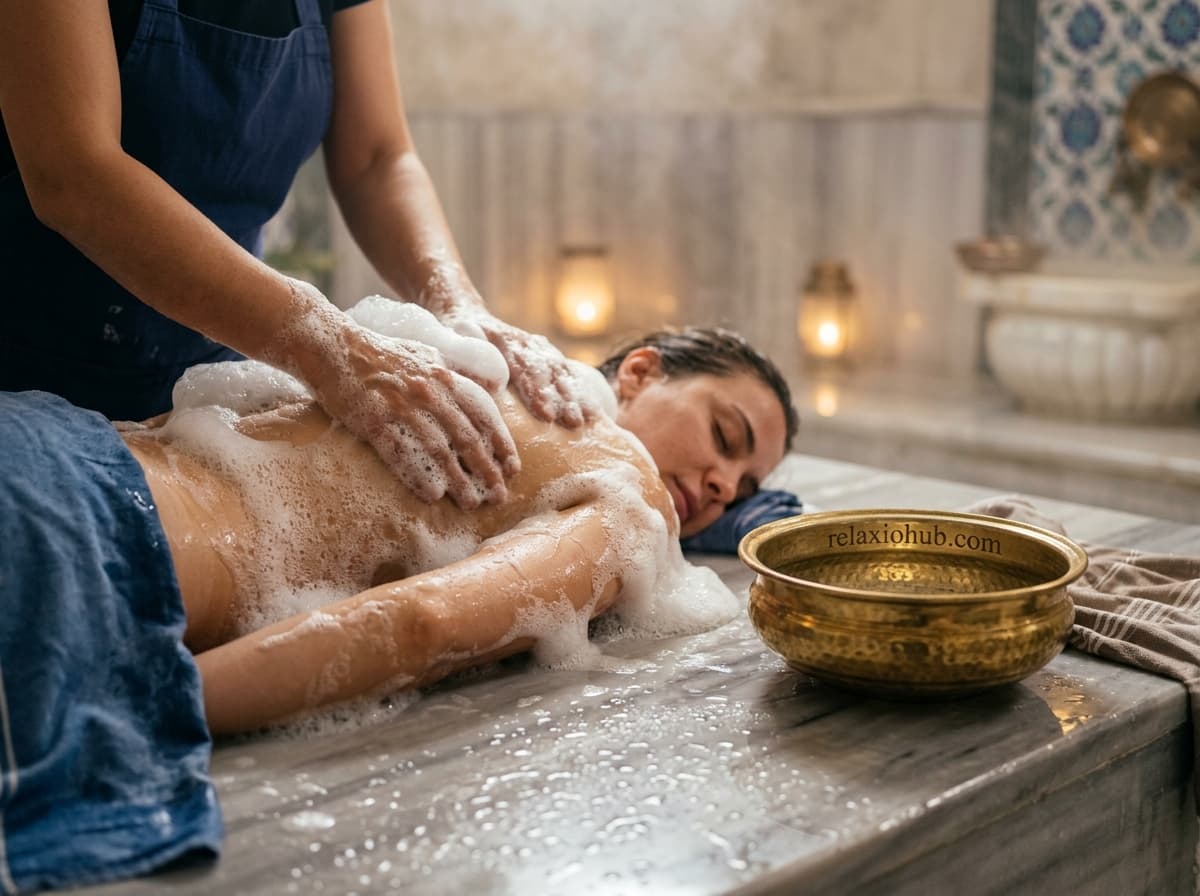
Bath before touch
Traditional hammams move heat through steam, warmed floors, and marble slabs that hold steady temperature under the dome. Skin softens from humidity plus heat—then the signature touch arrives: a coarse-silk or cellulose kese mitt lifts dull cells, and tellak-style hands stretch olive-soap foam across the body in rhythmic circles. Skip that warmup and you are back to scrubbing dry skin—so the bond between sauna-like space and massage is literal: heat opens the canvas, the massage uses the resulting glide.
The ritual grew alongside Mediterranean and Ottoman bathhouses as hygiene, social life, and slow time. Historic tellaks guided guests through graduated rooms, washed and foamed bodies, and kept footing safe on wet stone. Contemporary spas often compress the flow while keeping the same backbone: steam or radiant heat, scrub, foam, rinse, rest.
When reading studio profiles, check whether there is a real steam room or hot slab, or whether Turkish hammam here means a soap massage on a table after an infrared booth. Both can feel wonderful—just expect a different link to classical hammam architecture.
At a glance
Sensory map
Room names differ, but the story repeats: heat, scrub, foam, rinse, rest.
Breath deepens, skin turns supple under light fingertips without aggressive pressure.
Stone stores gentle, even warmth so your shoulders drop before the mitt returns.
Textured sweeps along preheated skin; shoulders, back, legs, and arms wake up without chasing redness as a trophy.
Dense lather is worked by hand or through a cloth sack—broad, slow circles that feel like washing and massage at once, especially silky post-kese.
Warm or cool water finishes the session; some venues add herbal tea downtime.
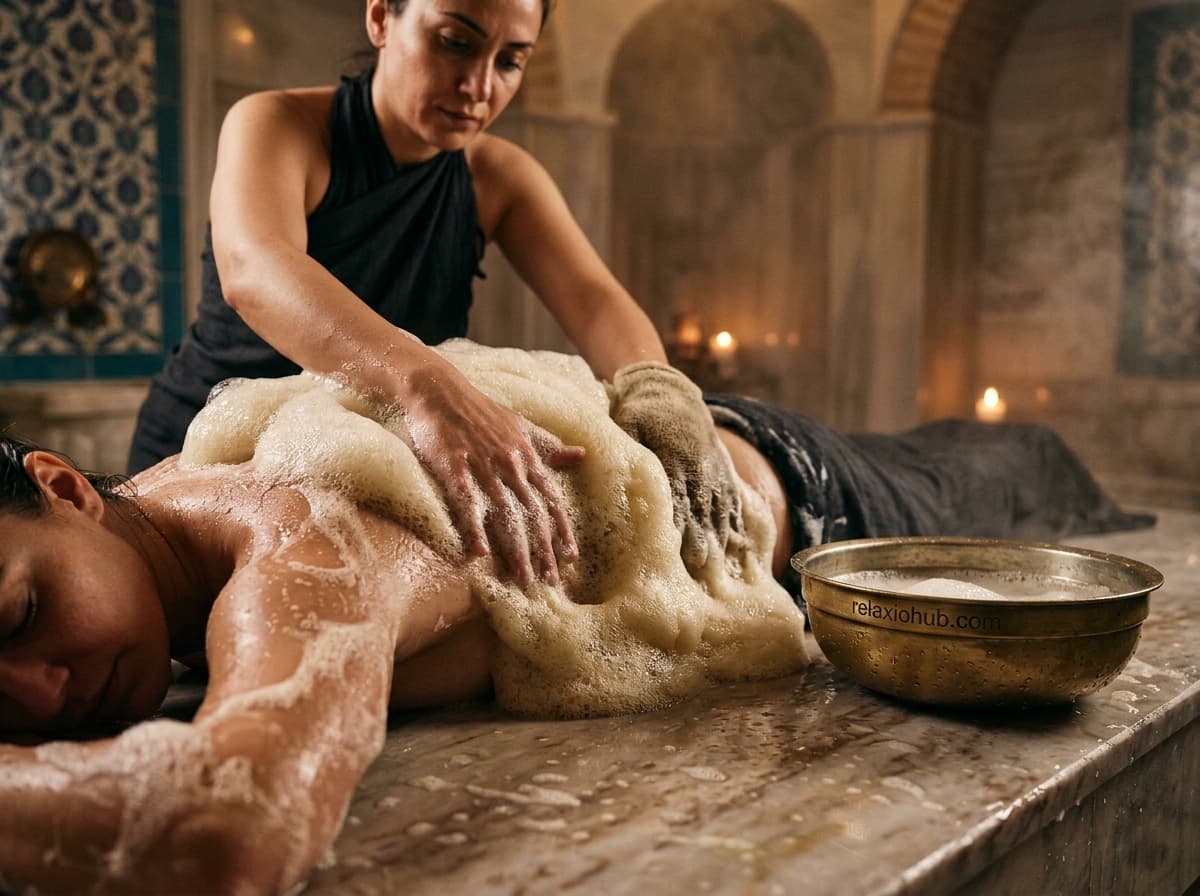
Why people book it
Embodied outcomes—not promises to cure a diagnosis.
Backs and necks often feel lighter after steam even before deep kneading begins.
Mechanical polishing on warm tissue reads immediately on palms and in the shower afterward.
Olive soap leaves a soft film that rinses away cleanly with cool water.
Repeated choreography lowers mental sprinting better than a short table rub without warmup.
Steam elevates stratum corneum moisture content and reduces transepidermal water loss after the ritual — a measurably different outcome from dry-sauna heat where the horny layer stays relatively dehydrated.
In moist heat, evaporative cooling is less efficient, so the body increases cutaneous blood flow to dissipate heat — producing more pronounced peripheral vasodilation than in dry-air saunas.
Timeline
Steam stresses the cardiovascular system; unstable pregnancy or acute issues mean postponing.
Staff should state how many minutes first-timers stay and where to sit to avoid overheating quickly.
Voice and hand signals steer depth; pain is not the goal even on rough skin.
Nausea or pounding temples after steam are reasons to stop immediately—not to tough it out.
Comparison
Three heuristics without crowning a single winner.
Turkish hammam matches that story; Finnish-style sauna is a different heat-transfer story.
Classic massage without steam starts from a different skin baseline—ask whether steam exists on site.
Choose targeted protocols after clinician clearance; hammam focuses on cleansing relaxation first.
Steam and hot slabs add cardiovascular load and overheating risk.
FAQ
Humidity is typically higher and moist heat often feels gentler on breathing; dry saunas behave differently—expectations and cautions shift.
It defines the exfoliation story; with dermatitis or broken skin the step shortens or changes by mutual agreement.
Only with individual OB clearance—steam loads the cardiovascular system and demands a stable pregnancy.
You may feel temporary relief from tightness in wellness settings, but it is not a substitute for evaluating chronic or acute pain.
Look for photos of real steam or honest disclaimers about adapted programs, cardiology red-flag scripts, and clear kese-and-foam explanations.
Moist steam at 40–50°C swells the stratum corneum — bonds between dead keratinocytes loosen. The coarse kese mitt then mechanically lifts the desquamated cells, forming characteristic rolls — normal keratin shedding, not toxin release. The visible effect is far greater than after a dry sauna where the stratum corneum stays relatively dehydrated.
The göbek taşı — belly stone — is the heated marble platform at the centre of a traditional hot room. Marble delivers conductive heat at a stable ~40–45°C across the full body-contact surface, distinct from convective air heating in a Finnish sauna or infrared radiation. Bilateral even-surface heating of large muscle groups primes the stratum corneum for kese more effectively than unilateral or point-source heat.
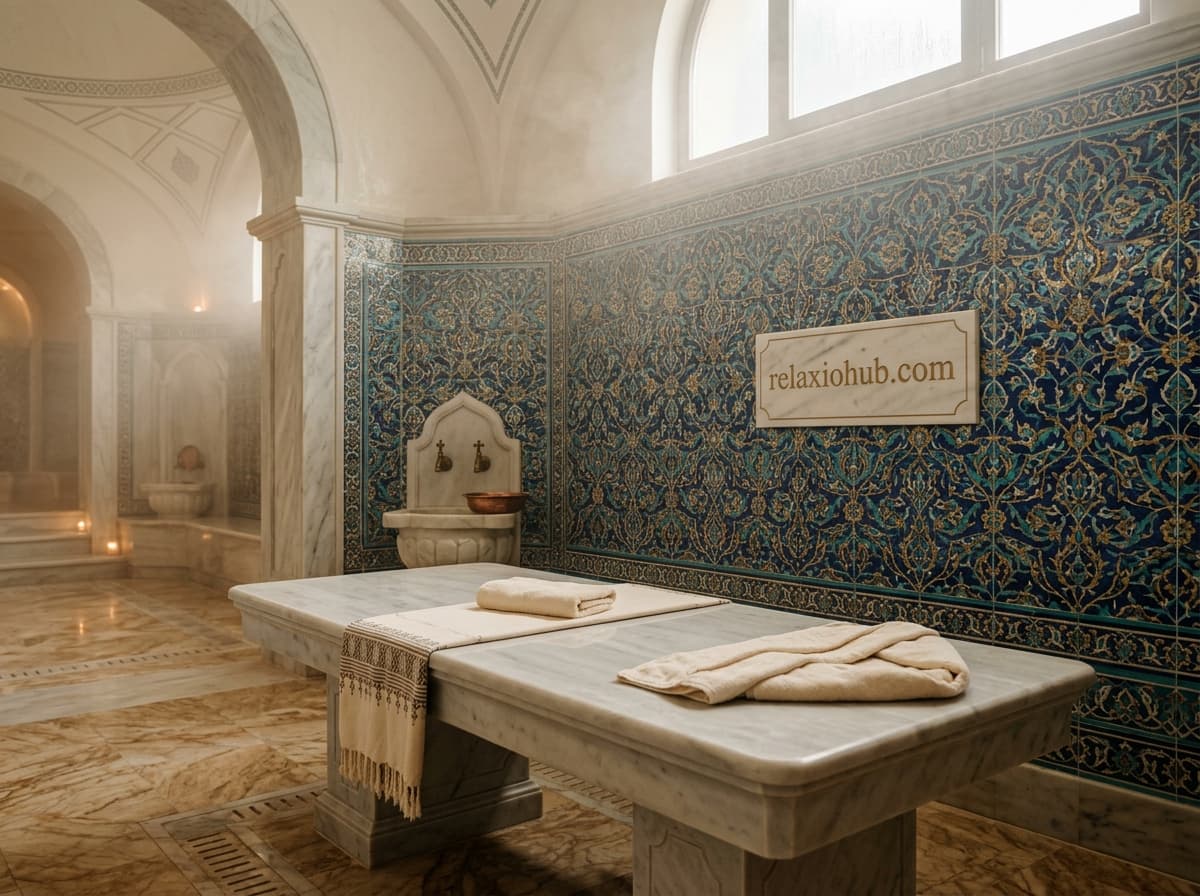
After steam and kese, lather spreads evenly—wide soap circles read as massage, not scraping cold tissue.
Compare profiles that show real steam and marble, publish heat rules, and refuse hot-room bookings when serious contraindications appear.