Palpation of the taut band and nodule hunting
The therapist glides along the fiber while you flag the familiar referral echo—not just local ache but "yes, that is the one" recognition that confirms the address.
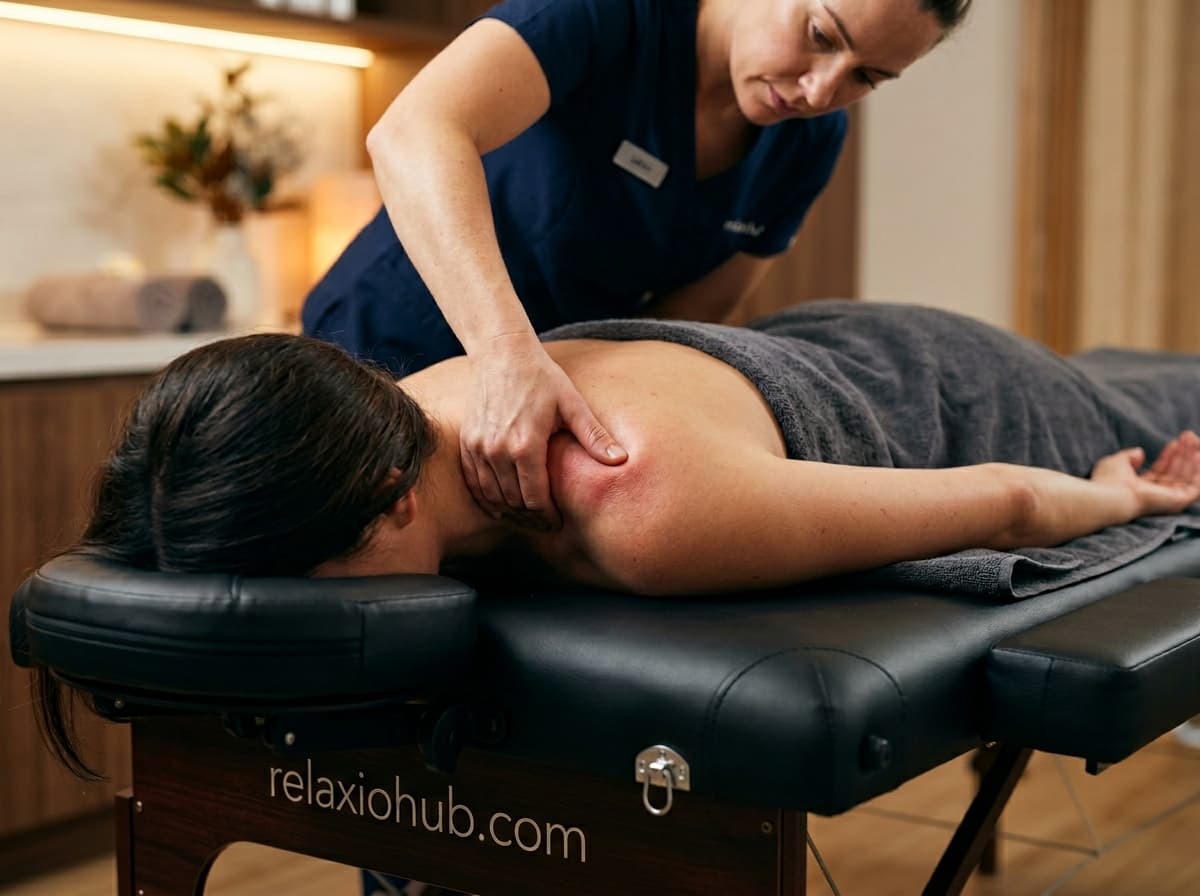
Protocol of negotiated static pressure on a palpable knot that may shoot discomfort to a predictable neighbor zone: short waves of intensity trade for a melting "tissue thread" feel and easier range—no instant disc-fix promises, and no glossing over when pain behaves like nerve tissue, not muscle.
Search intent
Searchers mix "trigger points," "muscle knots," "referred pain," and "myofascial pain"—all describing a hyperirritable nodule in a taut band of skeletal muscle, what Simons and Travell termed a zone of sustained depolarization. In studio practice the therapist slides along the muscle belly, palpates the ropy band, finds the focal nodule, then applies steady compression while you breathe and report a 1-10 comfort scale. Pain can sit under the finger or travel along textbook referral sketches—supraspinatus toward lateral arm, for instance. Distinguish that from lightning nerve zings, spreading numbness, or feverish swelling without a diagnosis: those belong to a clinician first.
Compared with relaxation Swedish, there is less glossy effleurage across every surface and more clocked seconds to minutes on specific coordinates. Compared with slow global myofascial release, language centers the knot-and-referral plot more than generalized fascial drag. Compared with deep-tissue "stripe the whole back" sessions, there is less acreage coverage without a prior pain map—trigger point protocol requires your confirmation ("that is the spot") before depth escalates. Experienced practitioners also address satellite triggers—secondary nodules that form in referral zones of a primary trigger—which often explains why the "main" knot returns after apparent clearance.
Important boundary: one visit can meaningfully unkink a frozen shoulder catch or temple headache pattern, yet it never replaces MRI, injections, or rehab programs when indicated. For practitioners and educators: rapidly distinguishing active from latent trigger points and reading referral maps per Simons and Travell is a foundational competency for any therapist doing pain work; trigger point certification modules frequently serve as an entry ramp into orthopedic and structural massage. Anyone guaranteeing permanent pain deletion with zero lifestyle homework is selling comfort, not outcomes.
Snapshot
Technique
School names differ; this reflects post-Google review talk tracks.
The therapist glides along the fiber while you flag the familiar referral echo—not just local ache but "yes, that is the one" recognition that confirms the address.
Steady pressure across several breath cycles; you regulate depth in real time—"softer" or "hold there"—without stoic suffering or white-knuckling through sharp pain.
Some protocols alternate micro-contractions with exhale release to reduce the protective guarding reflex and invite tissue to let go without escalating discomfort.
Light effleurage and gentle heat ease skin-level guarding; trigger-phase pressure never opens cold—the tissue needs to signal readiness before depth arrives.
After the localized intensity waves, the therapist allows the nervous system to settle the "ringing" with smooth finishing strokes—rushing the exit halves the gain.

Why book
Local ease and smoother motion—not diagnosis erasure.
Useful when sleep, desk posture, or gym volume locks a shoulder or neck hinge with a familiar snagging sensation.
Ethical therapists sketch where nodes can echo without mystical hand-waving or alarm-raising over-diagnosis.
Neuro deficits, roaring inflammation, or sudden systemic illness should pause any pressure plan—not override it.
You learn productive tension versus panic escalation in the nervous system—and stop fearing your own body signals.
When a knot clears, the movement ease is often noticeable before you leave the table—results you feel, not weeks you wait for.
Bi-weekly or monthly maintenance sessions keep chronic nodes in a manageable state far better than one intense assault per year.
Flow
"Tired office ache" versus "fell off a ladder yesterday" changes choreography.
Without your nod, depth should not escalate blindly.
Discuss straps, sleep posture, unilateral bag weight—practical not preachy.
Compare modalities
Three signposts, no universal champion.
Trigger or hybrid plan; diffuse pain without a focal driver may need medical triage first.
Pure myofascial release can stay broader; trigger work wants a sore lighthouse.
Classic deep-tissue sprints differ; trigger sessions trade acreage for cartography and pauses.
Non-exhaustive—pair with physicians when unsure.
People also ask
Not one-to-one: deep work can broad-brush large territories; trigger care hunts a node plus referral arc with timed breath holds.
Referred pain from trigger points follows common maps; illogical patterns deserve medical review before more thumbs.
Local tenderness can happen; escalating sharp pain or swelling means pause DIY fixes and escalate care.
Some feel shifts after one visit, others monthly; chronicity, sleep, and stress write the calendar.
Maybe gently; blind aggressive scapular-edge smashing risks ribs or nerve irritation—learn placement from a pro.
Look for neuromuscular or orthopedic massage training, transparent intakes, neuro-symptom boundaries, and zero "disc cure in one go" spam.
Price varies by session length and therapist experience: a focused 45-minute session costs less than a 75-minute protocol with intake mapping. Browse profiles and read descriptions—a detailed trigger point protocol typically costs more than a generic "deep back massage" offering.

Shoulder angle exposes textbook zones—smooth intent beats pain-as-a-trophy mindset.
Therapists
Practitioners across Ukraine who provide this massage type. Choose a specialist and view their profile.
Compare profiles citing trigger point or neuromuscular coursework, honest pain histories, and red-line ethics.