Explaining the tool and sound
Before starting, the practitioner shows the mallet and wedge and explains where tapping will happen. You know in advance how the wood will sound and exactly how to signal if the rhythm is too strong.
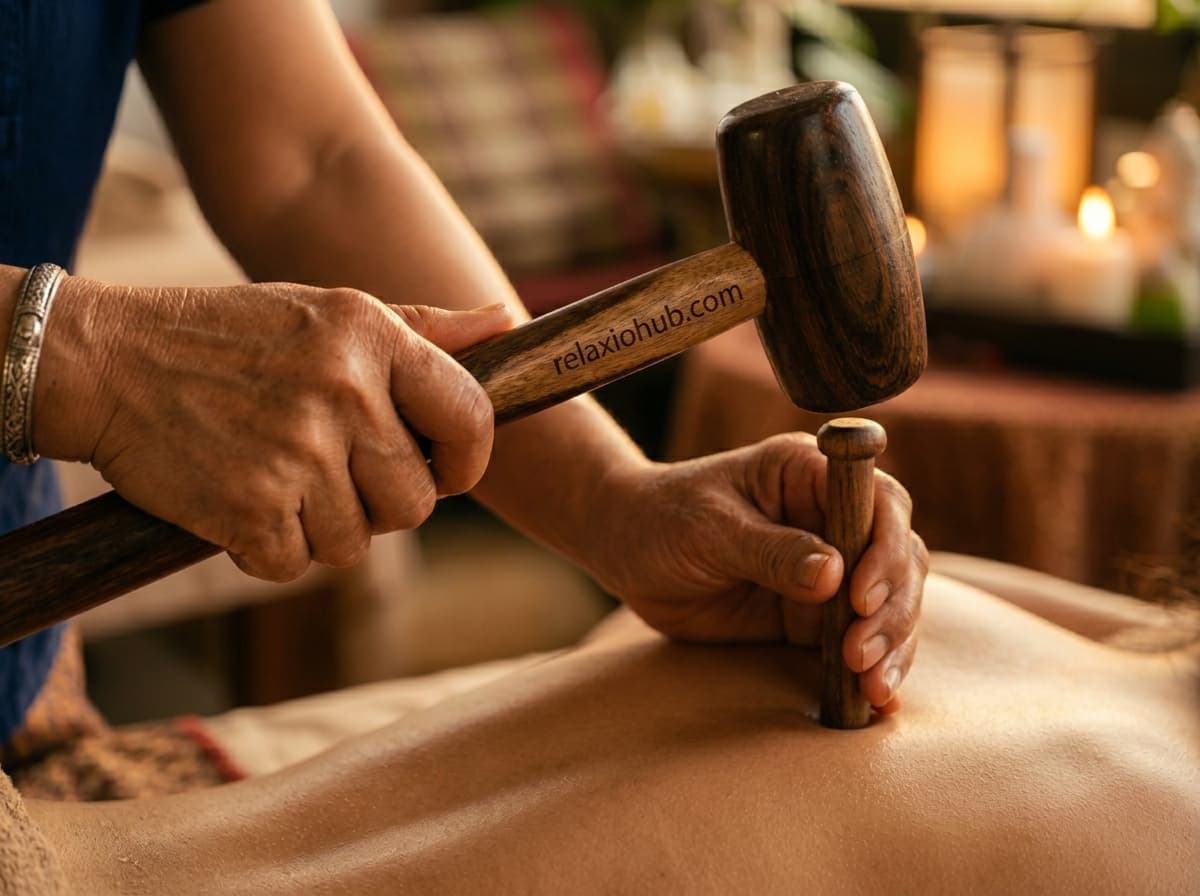
Tok Sen is a Northern Thai Lanna practice where the practitioner works not through hand strength alone, but through rhythmic tapping of a wooden mallet on a wedge: a soft vibration travels along body lines and helps tissue sense a different, less guarded rhythm.
Lanna bodywork
The body registers Tok Sen before the mind catches up: a rhythmic wooden sound, a soft wave through dense muscle, the sense that something releases — not from force, but from precise rhythm. The practice is rooted in Lanna culture in Northern Thailand, where traditional bodywork passed through families and temple lineages across Chiang Mai and Lamphun. The name is usually read through two words: tok — to tap, and sen — body lines in Thai tradition.
The tools are cut from hardwood; the tradition often names tamarind and other woods that produce a clean sound and resilient contact. The practitioner sets the wedge on a muscular or fascial area and taps it in short series. The 'tok-tok' sound becomes part of the session: the body receives not only pressure but a wave that can travel through shoulders, back, glutes, legs, or feet.
Today Tok Sen is practiced primarily in Thailand — in Chiang Mai and Thai massage schools. Outside Thailand, it appears in Thai bodywork studios and spas in the United Kingdom, Germany, the Netherlands, Romania, Spain, and other countries. Treat it as a cultural wellness method, not a medical procedure: Tok Sen may create a sense of easier movement and deep relaxation, but it does not replace clinical care.
At a glance
Process
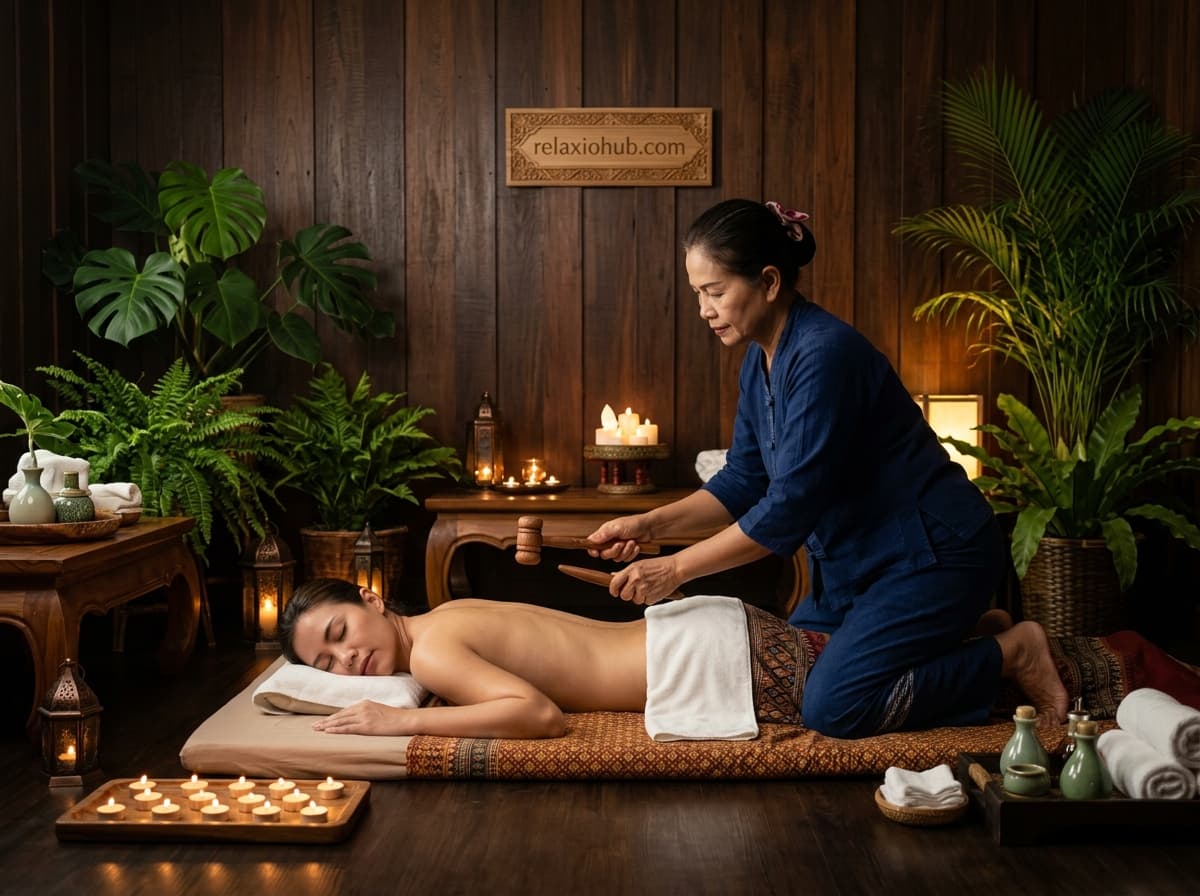
A session can combine manual warm-up, work along Sen lines, tool tapping, and a calming finish.
Before starting, the practitioner shows the mallet and wedge and explains where tapping will happen. You know in advance how the wood will sound and exactly how to signal if the rhythm is too strong.
Hands prepare the back, shoulders, legs, or feet — you feel the body gradually accepting touch and softening before the wedge ever makes contact.
The wedge is placed along muscular and fascial directions. Short tapping series alternate with pauses — between each, you can sense the vibration settling deeper into the tissue.
On denser areas, the pause between strikes lets vibration fully land before the next pass; on surface zones the rhythm lightens and quickens to match what the tissue can receive.
After tool work, the practitioner returns to hands. Tissue settles, and the body can finally register the result without any residual ringing edge of tension.
Expected effect
This describes wellness-session sensations, not treatment guarantees.
The wooden rhythm may pass through dense areas without requiring the same heavy hand pressure.
Tapping creates a clear sensory signal: you understand where tissue reacts more rigidly.
After work on the back, pelvis, or legs, some movements may feel less guarded.
A good session blends the mallet with manual tissue checks and constant feedback.
Repeating sound and gentle vibration can feel almost meditative if wooden sound is comfortable for you.
Bruising, numbness, or sharp pain means the force, area, or method is wrong for the moment.
Timeline
The practitioner asks about injuries, vascular risks, sensitivity to tapping, pregnancy, osteoporosis, and neurological symptoms.
Before tool work, the body is introduced to touch so rhythm is not experienced as an attack.
Tapping comes in series along selected lines; the practitioner changes angle, force, and tempo.
After each important area, say whether a pleasant wave remains or discomfort appears.
The session ends softer so the nervous system does not stay in sharp-stimulus mode.
Comparison
Tok Sen belongs near Thai tradition but feels very different because of the tool and sound.
Tok Sen fits when you are curious about wood, rhythm, and vibration rather than hands alone.
Classic Thai massage may fit better if mallet sound or vibration makes you tense.
Deep tissue massage is closer to direct mechanical pressure without wooden tools.
Tool tapping needs extra care where tissue, vessels, or nerves are vulnerable.
FAQ
It is a Northern Thai Lanna practice where a wooden mallet taps a wedge, transmitting vibration along body lines.
The method's roots are in Northern Thailand, especially the Lanna cultural region around Chiang Mai and Lamphun.
Primarily in Thailand. It is also taught or offered in Thai bodywork schools and spas in the UK, Germany, the Netherlands, Romania, Spain, and other countries.
It should feel rhythmic and noticeable, but not sharply painful. Fear, burning, numbness, or bruising means intensity is wrong.
Look for Tok Sen training, an explanation of the tools, contraindications, working zones, and how the practitioner controls tapping force.
Traditional Thai massage works with hands, elbows, and passive stretches. Tok Sen adds a wooden tool: the mallet and wedge create a vibrational wave that is difficult to replicate with finger pressure alone. Sound and rhythm are as much a part of the session as physical contact.
Most people notice a shift after the first session — usually a sense of easier movement or deeper relaxation. For a more lasting effect, practitioners typically suggest three to five sessions, though the right number depends on personal goals and how each individual's body responds.

Tok Sen requires precision: the same tool can feel calming or too sharp depending on angle, force, and rhythm.
Therapists
Practitioners across Ukraine who provide this massage type. Choose a specialist and view their profile.
Look for a practitioner who describes where they trained in Tok Sen, how they work with Thai Sen lines, and how they explain contraindications. A profile with specific answers is a better sign than a generic mention of Thai massage experience.