Warm-up effleurage
Long enveloping strokes raise superficial warmth, improve hand-to-tissue contact, and let the therapist sense where muscles feel denser or guarded after recent training.
Targeted manual work after which calves stop burning, hips move with ease, and your next session starts from a rested baseline — not from battling the accumulated fatigue of the day before.
Massage overview
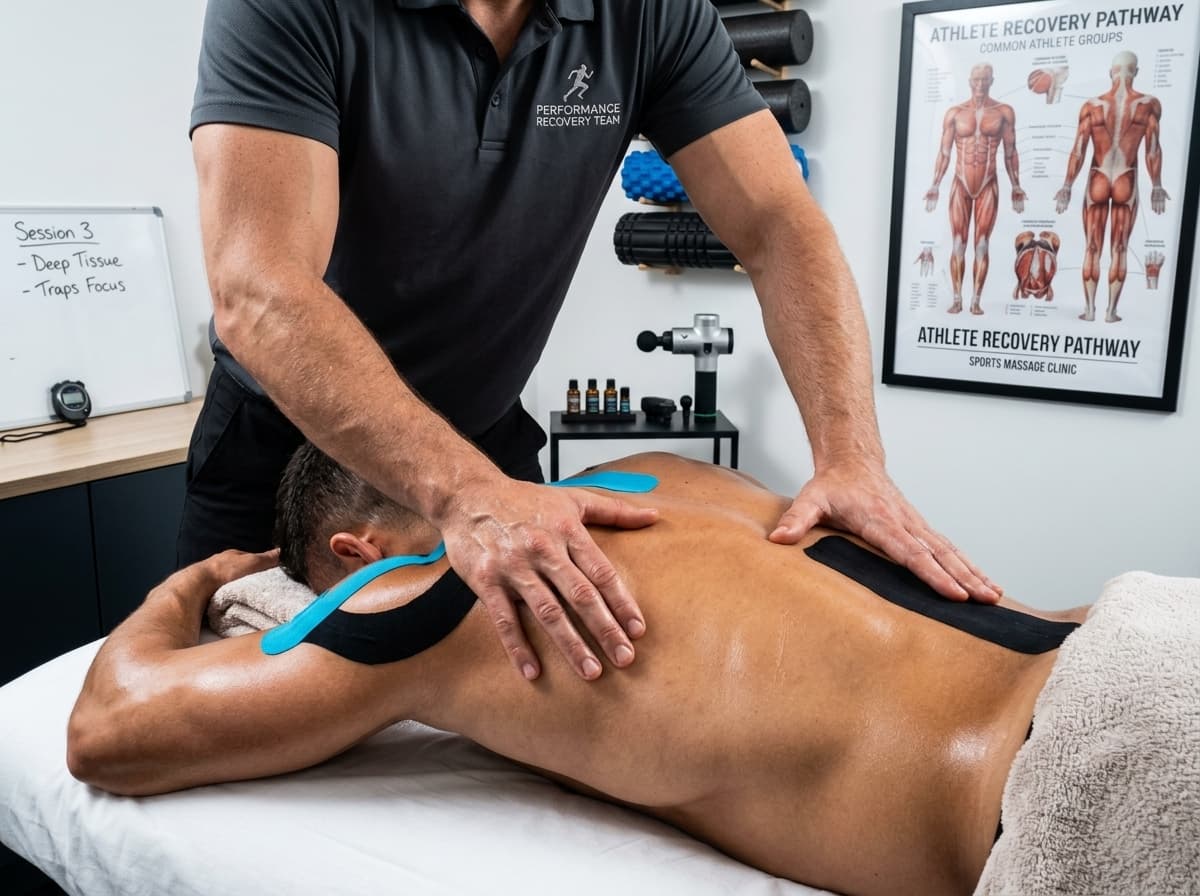
Sports massage is structured manual work with muscles, fascia, and connective tissue built around the logic of a training cycle. It emerged from sports medicine as a way to help tissues recover after demanding efforts, but today it attracts recreational athletes just as often — runners, cyclists, gym-goers — anyone who regularly experiences the characteristic 'concrete legs' sensation after a hard session. The goal is not to push through pain, but to help tissues return to a calmer resting tone, reduce the intensity of DOMS (delayed onset muscle soreness, which peaks 24–48 hours after effort), and prime the highest-load zones for the next training block.
Unlike a purely relaxation-focused session, sports massage has a sharper focus. The therapist maps your training schedule, types of discomfort you feel during movement — not a medical diagnosis, but a practical tissue map — and the primary stress zones for your discipline: calves and knees in runners, IT band and quads in cyclists, shoulders and traps in swimmers. The arc moves from warming superficial layers into deeper compression, then closes slowly, shifting the nervous system from sympathetic dominance — the exercise state — toward parasympathetic recovery.
It is important to understand the limits: sports massage is not rehabilitation after acute injury and is not medical treatment. Swelling, sharp pain on movement, suspected tears, fractures, active infection, or acute inflammation all require clinical evaluation first. Massage earns its place in the recovery rhythm between stable sessions — when tissue condition is settled and contraindications are ruled out.
At a glance
Technique
Exact formats vary by practitioner and sport, but the session logic is consistent: prepare tissues, address sport-specific muscle chains, reduce localized overload sensations, and close with recovery-friendly pacing.
Long enveloping strokes raise superficial warmth, improve hand-to-tissue contact, and let the therapist sense where muscles feel denser or guarded after recent training.
Rhythmic pressure and kneading ease heaviness in thighs, calves, or back after high-volume days. Depth ramps up gradually to avoid sudden protective muscle guarding.
Slow passes along fiber direction help redistribute tension in overloaded areas and support local microcirculation. It feels intense yet controlled when communication between client and therapist stays open.
Targeted short movements address specific zones — traps, lumbar tissue, or areas near knees and ankles after heavy lifting — without aggressive jerking or forceful grinding.
Deliberate slow finishing techniques steady breathing and activate the parasympathetic response, helping the body shift from gym-driven arousal into genuine recovery mode and reducing the risk of feeling wrecked right off the table.
Effect
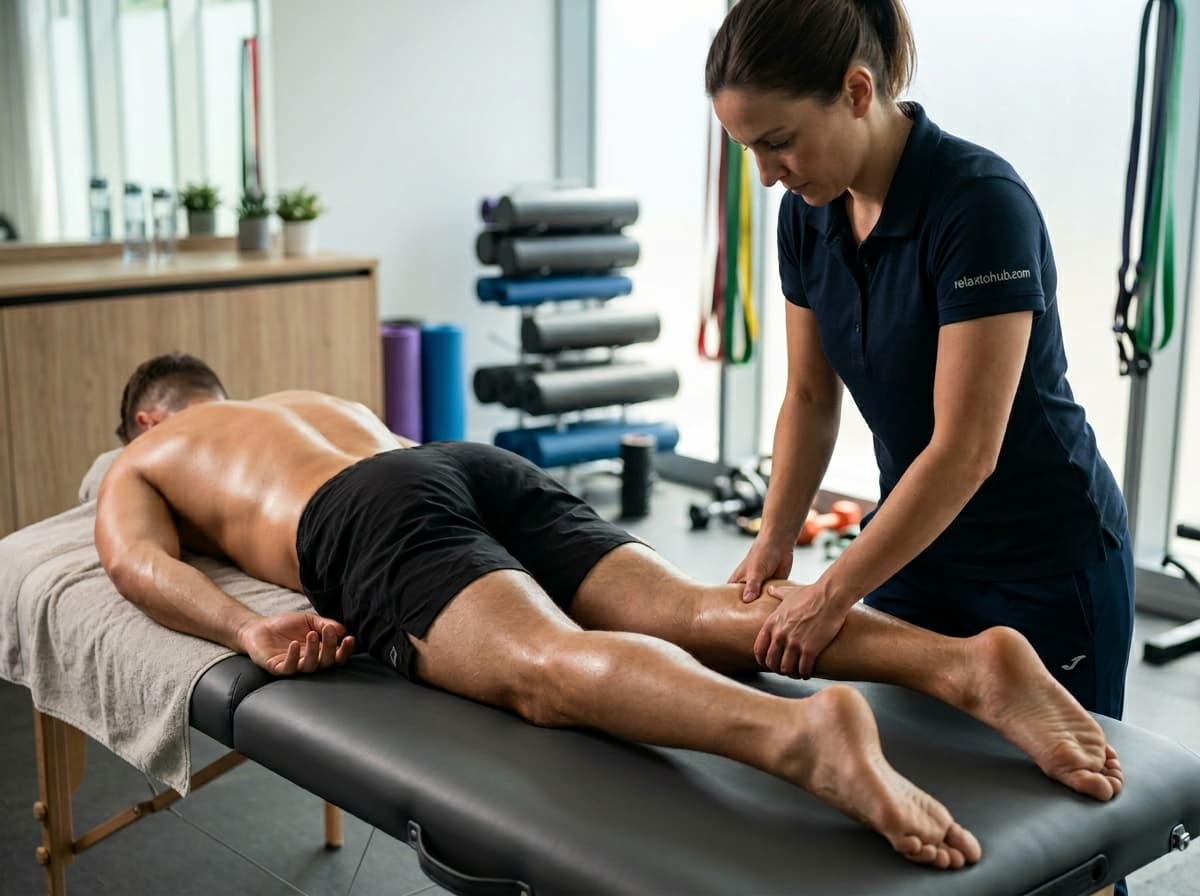
Results vary with sleep quality, hydration, training load, and absence of acute conditions. Below are realistic outcomes that active clients and sports physiology research consistently support.
Rhythmic compression promotes local blood flow, helping tissues receive oxygen and nutrients more efficiently — especially noticeable after prolonged aerobic efforts.
Delayed onset muscle soreness peaks 24–48 hours after demanding sessions. Sports massage can reduce the perceived intensity of DOMS and shorten the time to comfortable movement.
After running, squatting, or volume cycling days, massage measurably improves movement quality the next morning — especially during high-load accumulation phases.
Intensive training progressively tightens fascial layers around muscle groups. Slow deep work along fiber direction restores glide between tissue layers and returns the sensation of easy, unrestricted movement.
A deliberate slow closing phase activates the parasympathetic response — the physiological shift from exercise-driven sympathetic dominance into recovery mode, supporting better sleep quality.
Sessions can match your micro-cycle: lighter and stimulating before key efforts, deeper and comprehensive on rest days between hard training blocks.
Process
You discuss recent workouts, upcoming races or competitions, pain locations, injury history, primary stress zones for your sport, and pressure comfort boundaries.
The therapist prepares tissues with surface work, then applies deeper compression and friction to the muscle chains most loaded by your specific activity.
The session ends with slow strokes: breathing steadies, nervous system stabilizes. Time is given for brief practical guidance on hydration and the next training session.
Choosing the format
Common search intents: post-gym recovery, pre-race priming, or maintenance between micro-cycles. The right session matches today's tissue state — not a generic internet template.
Prefer a calmer arc: emphasis on warming, kneading, and a long recovery close. Aggressive depth immediately after extreme loading should be cautious — and avoided entirely if swelling or sharp pain is present.
The ideal window for deeper calf, quad, hamstring, IT band, or back work. A 75–90 minute session allows thorough coverage without rushing the closing phase.
Shorter (30–45 min), lighter, and more stimulating — no maximal-depth stripping on unfamiliar areas. The goal is to activate tone and circulation without leaving muscles over-relaxed or sensitized. Confirm format expectations with the therapist in advance.
Sports massage is inappropriate for acute injuries, suspected fractures, feverish illness, or unexplained swelling without clinical evaluation.
FAQ
Classic massage spans many relaxation and wellness styles. Sports massage is planned around your training load and sport-specific muscle chains, with timing and depth tuned for recovery between sessions — not just general relaxation.
DOMS (delayed onset muscle soreness) peaks 24–48 hours after unaccustomed or high-intensity effort and is caused by microtrauma in muscle fibers. Sports massage can reduce the perceived intensity of DOMS and speed the return to comfortable movement — it does not 'flush lactic acid' as was once believed, but it supports microcirculation and reduces residual muscular tension.
It depends on the goal. Pre-training: a short, light, stimulating session to activate tone — not deep work, which can leave muscles over-relaxed and reduce output. Post-training: deeper recovery massage, ideally 2–6 hours after the session ends, once the acute exercise response has settled.
Yes, but the format is very different: short (20–30 min), light, stimulating — no aggressive depth on unfamiliar areas. If you have never tried it before a race, schedule a trial session several weeks ahead to know how your body responds.
No. Warm-ups are active neuromuscular preparation for sport-specific movement patterns. Massage can complement recovery and support tissue readiness, but cannot substitute dynamic mobility work or activation drills before training.
During steady training: every 1–2 weeks is common. During peak preparation or high-volume phases: twice weekly is possible with professional guidance and no contraindications. Frequency should reflect training load, budget, and individual recovery capacity.
Acute injuries require diagnosis first — massage in the acute inflammatory phase can worsen the condition. After clinical clearance, once the acute phase resolves, massage may be incorporated into a rehabilitation program as a supportive method. Marketing claims about curing tears or structural damage are misleading.
Therapists
Practitioners across Ukraine who provide this massage type. Choose a specialist and view their profile.
Ольга
Valeria
Ірина
Марія
Поліна
Оксана
Віктор
Iлона
Василина
Сергій Олександрович
Katerina
Ірина
Choose your city on the home page and browse profiles listing sports massage or experience working with athletes.