Long effleurage warming both paraspinal gutters
Prepares skin and paraspinal muscles before focal load—aligning stroke direction with muscle fiber orientation, no stabbing of spinous processes.
Under this term studios usually mean structured work along the spine and neighboring skin-and-muscle fields tied to the same spinal level—not random kneading wherever it hurts tonight, but a deliberate pass through paraspinal gutters, intercostals, sometimes sweeping toward scapular arches or the lumbosacral loop after the map is named aloud. It often feels like bilateral warming stripes flanking the spine, sometimes subtle warmth forward into ribs or abdomen without ultrasound fantasies about your stomach lining.
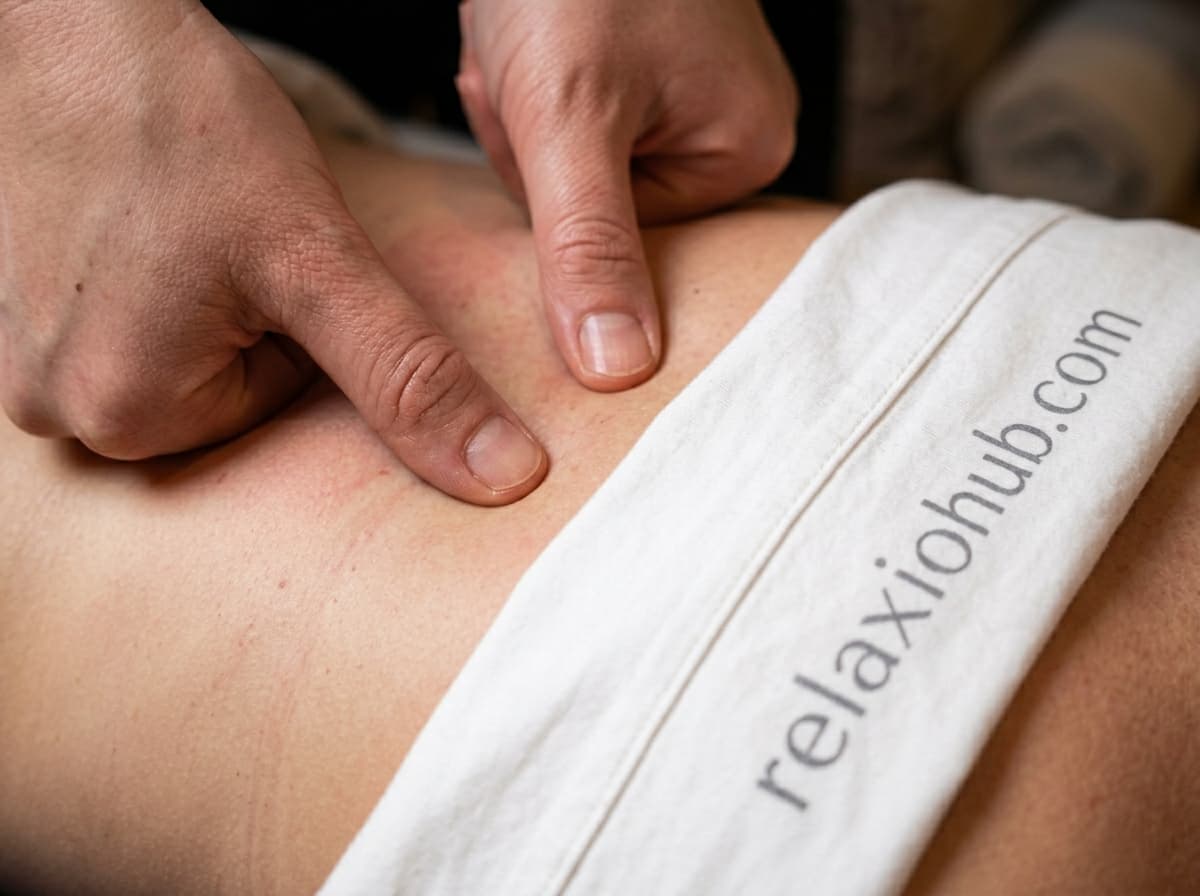
In the RelaxIOhub catalog
Physio-rooted texts frame segmental innervation as a three-way share: one spinal level covers sensory neighborhoods across skin, muscle, and visceral referral zones. Back in the late 1800s, neurologist Henry Head—and, independently, Russian clinician Zakharyin—mapped areas of skin hyperalgesia now called Zakharyin–Head zones: Th4–Th5 aligns with cardiac projection, Th7–Th9 with the epigastric region. Studios borrow the operational idea: methodically cover mid-thoracic or lumbosacral levels, work both gutters symmetrically, keep breathing easy, and skip bulldozing where you cannot exhale. Clear explanation sounds like 'we are targeting segmental tone and surface sensitivity'—not 'we ulcer-proof your stomach with elbows.'
Versus full-body Swedish relaxation, the accent stays bilateral beside the vertebral column with proportionally less marathon-only-leg work unless pre-agreed. Versus meridian acupressure the logic differs—closer to neurological dermatomes and the viscerocutaneous referral patterns of Head's zones, though every school redraws the borders. None of those wall posters replaces ECG, endoscopy, or imaging; ads promising organ cures from back stripes are a walk-away signal.
Realistic expectations: sessions may soften 'concrete' tension between shoulder blades or the low back, ease chest tightness after desk stress, help already-evaluated guests feel their torso segments again. Guaranteed disc fixes or organ healing without physicians are outside what professional massage can promise.
Snapshot
Technique
Course titles differ; bodies know whether work stays symmetrical and whether every zone earns a why before pressure climbs.
Prepares skin and paraspinal muscles before focal load—aligning stroke direction with muscle fiber orientation, no stabbing of spinous processes.
Symmetrical two-handed work flanking the vertebral canal—after depth consent, no percussion on bony tips.
Only after consent; breathing stays steady, never breath-holding competitions.
Works when the therapist ties it to your stated goal—less mystery in your head.
Lets the autonomic system register reduced tone.
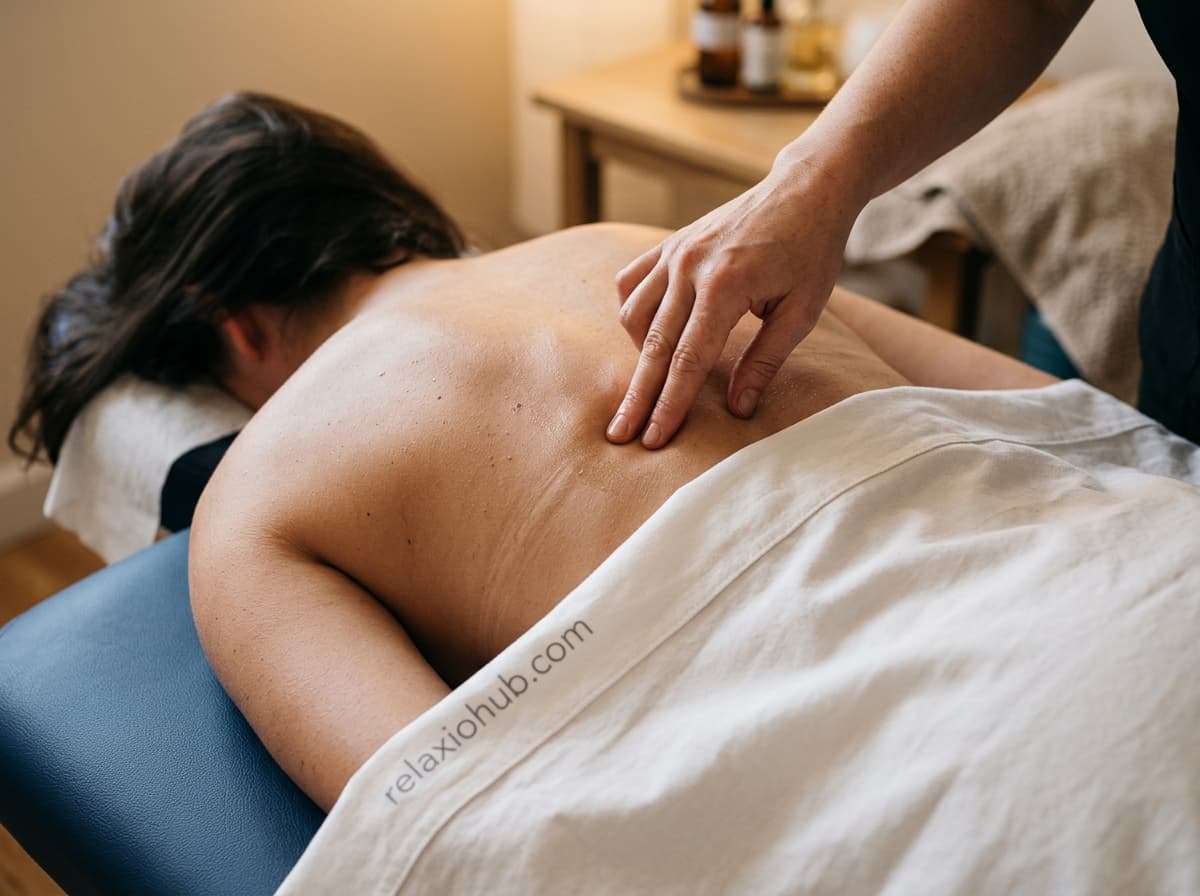
Why book
Muscle downshift and clearer segment awareness—no promises from wall charts alone.
Helps habitual one-sided loading and desk kyphosis patterns.
Often reads as 'unpacking' a specific stripe rather than spreading work evenly across the entire back.
Subjective breathing ease can follow—only when pressure stayed voice-rated and cooperative throughout.
Mature studios neither reinterpret chest pain as reflex paste nor make claims to read organs from a shoulder blade.
The therapist names why Th7–Th9 reaches the epigastric field and Th4–Th5 the cardiac projection—useful context for guests and practising professionals alike.
The protocol adjusts level by level from upper thoracic to sacrum—voice-rated comfort prevents one pressure setting from overriding anatomy.
Flow
Thoracic protocols especially need cardio-pulmonary honesty—do not minimize.
Zones are spoken before load ramps.
Hydrate, stroll gently; neurologic escalation belongs to urgent care—not same-day round two.
Compare
Three intents—no mandated champion modality.
Segmental-reflex formats usually match that brief.
Classic catalog pages cover that—negotiate emphasis before paying.
Different logic—see our acupressure or trigger-point explainers.
Paraspinal lanes neighbor serious clinical emergencies.
FAQ
Not in a SPA context. Charts are teaching tools; diagnosis requires clinicians and testing.
More deliberate time in symmetrical paraspinal gutters with segmental reasoning—not only global relaxation strokes.
Depends on stage and symptoms; acute radicular pain or neuro deficits need doctor-guided green lights.
Intensity is negotiated; pain that makes you brace is a stop signal, not mileage to endure.
Look for training notes, refusal policies around chest and acute belly pain, and zero organ-cure guarantees.
Zakharyin–Head zones are neurological teaching maps correlating spinal levels with skin hyperalgesia fields and visceral referral patterns. In-studio, they serve as an educational framework explaining why certain paraspinal bands are chosen—not a diagnostic tool and not a substitute for clinical workup.
One to three sessions usually give enough feedback to evaluate whether the format suits your body; ongoing frequency is decided with the therapist. Pricing is always listed on each practitioner's RelaxIOhub profile—no hidden 'zone-map' surcharges.
Therapists
Practitioners across Ukraine who provide this massage type. Choose a specialist and view their profile.
Compare profiles describing segment maps, realistic depth, and honest screening for thoracic and abdominal emergencies.