Intake and boundary mapping without diagnosing
The therapist logs injury or surgery dates, implants, painful movement arcs, and clinician veto zones — without playing radiologist or making clinical diagnoses.
Gentle manual work that returns sensation to skin, the first degrees of new range to a joint, and readiness to accept load to muscles that spent weeks under a cast, brace, or bed rest.
Recovery framing
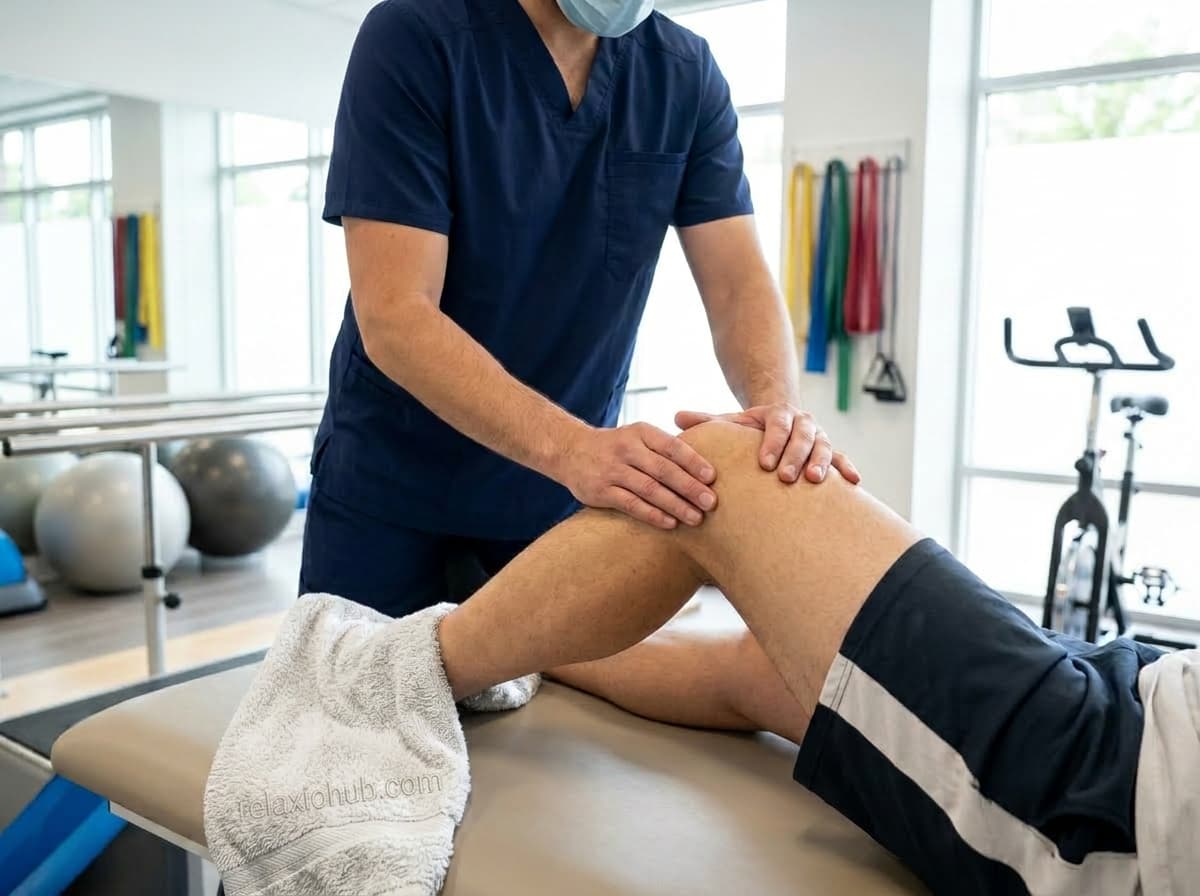
Studio rehabilitation massage begins where the acute phase ends: no throbbing rest pain, no hot swelling, no fever, no suture risk. After weeks of immobilization or surgery, the body changes in predictable ways — muscles partially atrophy, fascial layers adhere, joints lose range and develop contractures. The therapist's role is to gently restore tissue glide, reintroduce sensation to skin and deep receptors, and prepare the neuromuscular system to respond again to movement commands.
The defining feature versus general therapeutic massage is deliberate medical context: you share your diagnosis or injury date, brace or suture restrictions, and the zones cleared for touch today. A key component is scar tissue mobilization — once the skin has healed, the forming scar is denser than surrounding tissue and often restricts the glide of underlying fascia. Slow, superficial work over a closed scar reduces this tethering and restores elasticity. This is not a hospital protocol and does not replace prescribed physiotherapy — exercises and clinical reassessment stay with your physician or physical therapist.
Hard limits apply: without clearance after fresh fractures, infected wounds, unstable joints, or suspected complications, booking studio work is not safe. New dizziness, limb deformity, or inability to bear weight belongs in urgent care — not a massage table.
Snapshot
Technique
Broad contact and micro-amplitude loading instead of ballistic stripping across freshly remodeled tissue. The principle: invite, do not command.
The therapist logs injury or surgery dates, implants, painful movement arcs, and clinician veto zones — without playing radiologist or making clinical diagnoses.
Long enveloping strokes raise surface temperature, encourage lymphatic drainage from swollen areas, and allow tissues to communicate before more focused work begins.
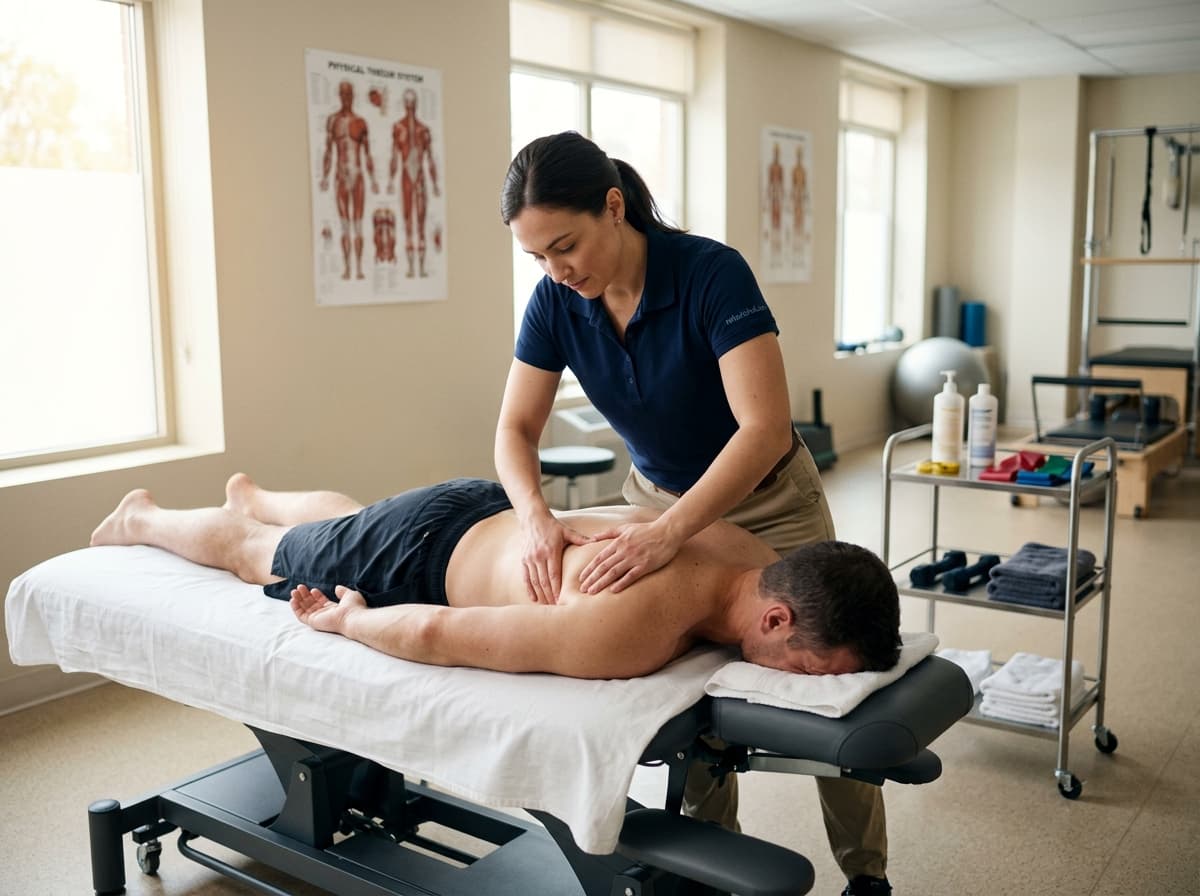
Only after full epithelial closure and absence of drainage: slow layer-on-layer shear softens scar adhesions, restores skin glide over underlying fascia, and reduces the armor-like tightness around incision lines or trauma sites.
Gentle resistance under a palm reactivates an atrophied muscle without jerks that stress freshly healed ligaments — an element of restoring neuromuscular coordination and proprioception.
Cold or heat reminders per physician protocol, safe self-stretch amplitude, and clear stop signals — so clients do not overdo it between sessions.
Why book
Typical intent: comfort bridging medical appointments and tissue preparation for PT homework — not closing the clinical chart on the massage table.
Load adapts to where you are today — freshly weight-bearing after a cast, or just beginning to rotate a joint freed from a brace.
Muscles resist the first bend or shoulder raise less when tissues have been gently reintroduced to sensation and touch beforehand.
Scar tissue is denser and less elastic than healthy tissue. Slow superficial work over a closed scar restores skin mobility and reduces tethering around surgical incisions or trauma sites.
Sensory receptors in muscles and joints are disrupted by injury. Rhythmic manual contact helps re-engage proprioceptive signals, supporting the nervous system's return to precise, coordinated movement.
An ethical therapist shortens or cancels a session at the first hint of doubt instead of pushing through client discomfort.
Tissues accept physiotherapy programming more cooperatively when prior protective guarding and spasm have been reduced through conservative manual work.
Flow
You demonstrate restricted movements; depth stays inside medically established limits and the therapist does not push for more range than your physician has cleared.
Warm-up effleurage, superficial scar mobilization where appropriate, and brief isometric micro-holds alternate with breath resets to avoid overwhelming the nervous system.
You leave with reminders about PT homework, safe movement amplitude, and clear red-flag symptoms that warrant medical evaluation — not another massage appointment.
Choosing the format
Three distinct scenarios — each different from sports performance recovery or relaxation-only booking.
You need sensation and gentle tissue glide restored — not aggressive joint stretching on day one. Contracture resolution happens gradually over multiple sessions.
Exercises have been prescribed but muscle remains over-braced or spasmed. Manual work can reduce that barrier and help tissues accept homework more fully.
Hardware is settled and acute symptoms are gone, yet the area still feels wooden or the scar tethers movement. Work stays slow and respectful — never simulating emergency care.
Acuity and instability override the urge to do something manual. When in doubt — see the clinician first.
FAQ
Therapeutic massage targets chronic desk tension or mild overuse. Rehabilitation massage explicitly respects an injury or surgery timeline and medical restrictions, and often includes specific techniques — scar mobilization, low-load isometrics, lymph-aware effleurage — not present in a standard session.
Timing is individual: typically after the acute inflammatory phase resolves — two to six weeks depending on the procedure — and only with clearance from the surgeon or physio. The first days after surgery belong to monitored medical settings, not studios.
Scar mobilization is slow superficial work over a healed incision that softens denser scar collagen and restores glide between skin and underlying fascia. It begins only after full epithelial closure — usually no earlier than six to eight weeks post-surgery or injury — with no active drainage and physician sign-off.
In the subacute and chronic phase — yes, with orthopedic clearance. Massage does not interact directly with the implant but can reduce protective muscle spasm around the joint, improve fascial glide, and prepare tissues to engage more fully with the prescribed PT program.
No. Physiotherapy builds motor control, strength, and movement patterns. Massage can ease PT execution by reducing protective guarding, but cannot substitute systematic movement-based rehabilitation.
Often once a week in the early subacute phase, or every 10–14 days during maintenance. Optimal frequency is coordinated with your physician or physical therapist based on tissue response.
Stop massage, document what appeared — where, what, when — and escalate to your clinician or emergency care depending on severity. Increased pain, new swelling, or fever after a session warrants medical evaluation, not another appointment.
Therapists
Practitioners across Ukraine who provide this massage type. Choose a specialist and view their profile.
Choose your city and read profiles for post-injury or post-surgery experience, requests for physician documentation, and conservative pacing without miracle-healing promises.