Professional-grade heaters
Stones live in calibrated baths—not improvised microwave guessing games.
Radiant heat layered along your spine and shoulders plus therapist hands between stone placements—less abrupt pinpoint pounding, more gradual easing through stubborn grip zones.
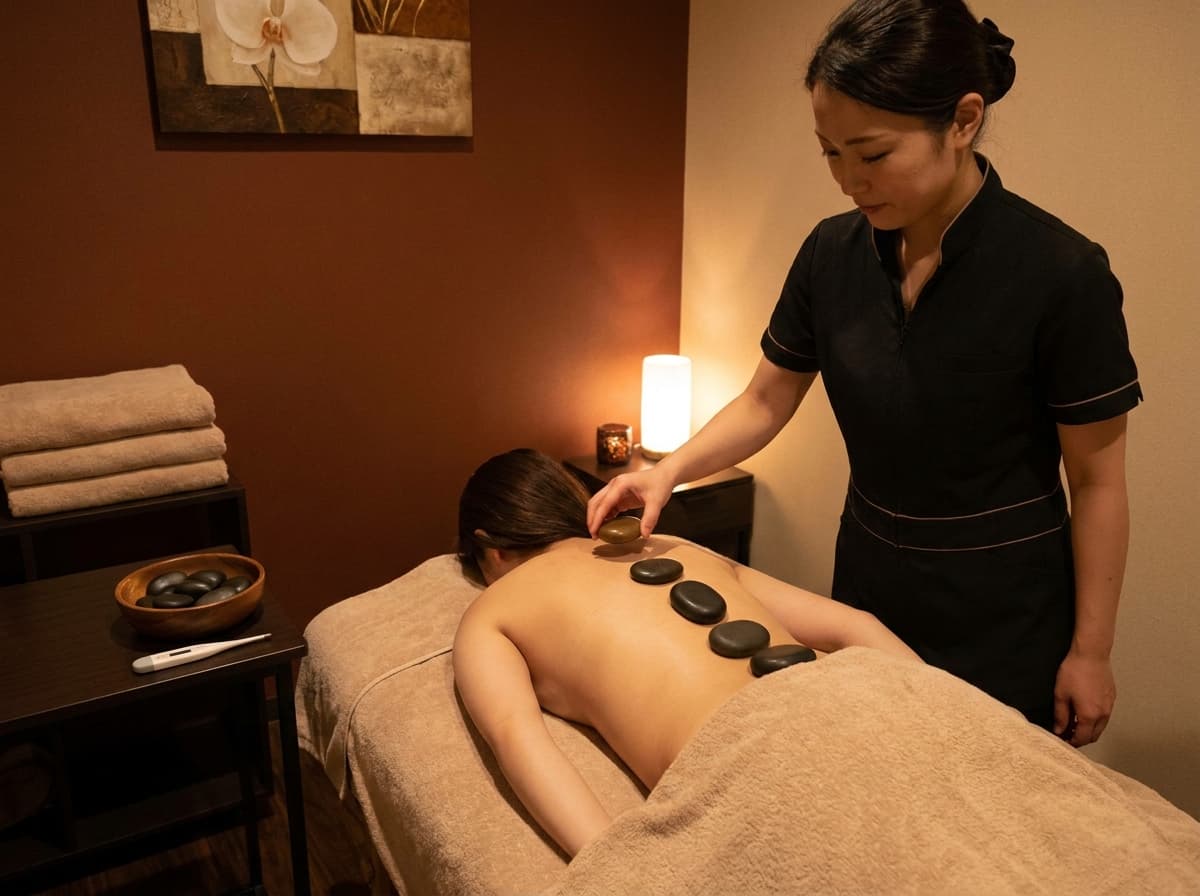
Massage overview
Modern studios describe heated smooth stones—typically dense volcanic basalt—as tools that slowly release heat into skin and superficial muscle layers. Basalt's fine-grained crystalline structure gives it exceptional thermal mass: it absorbs heat evenly and releases it gradually without spiking, which is why it became the industry standard taught in stone massage certification courses. Therapists alternate quiet placement along the back, hips, or soles with active work: gliding the stone through carrier oil or classic palm strokes between warming cycles.
Sessions worth trusting begin before stones touch skin—sharing neuropathy, recent burns, pregnancy without obstetric sign-off, fever, unstable blood pressure, or blood-thinning medications lets professionals adapt protocols or reschedule entirely. Hot stone massage supports restorative wellness—it never replaces diagnosis or cures pathology.
Guests often seek stones during colder seasons, after desk-heavy weeks, or when craving relaxation depth without aggressive trigger chasing. Heat should feel deep-warming, not sharp-burning; steady redness with blister risk means pause protocols—not bravery.
At a glance
Technique
Lineages vary, yet credible studios unify thermometer-backed warming with predictable pacing.
Stones live in calibrated baths—not improvised microwave guessing games.
Pairs trace para-spinal lanes or anchor shoulder blades while other limbs receive manual attention simultaneously.
Broad convex stones sweep slowly—felt pressure spreads wide rather than pinching tiny knots.
Palms rehearse tissue readiness before hotter stones arrive, smoothing fascia transitions.
Finishes tend softer unless contrast protocols—cold stones—were contracted upfront.
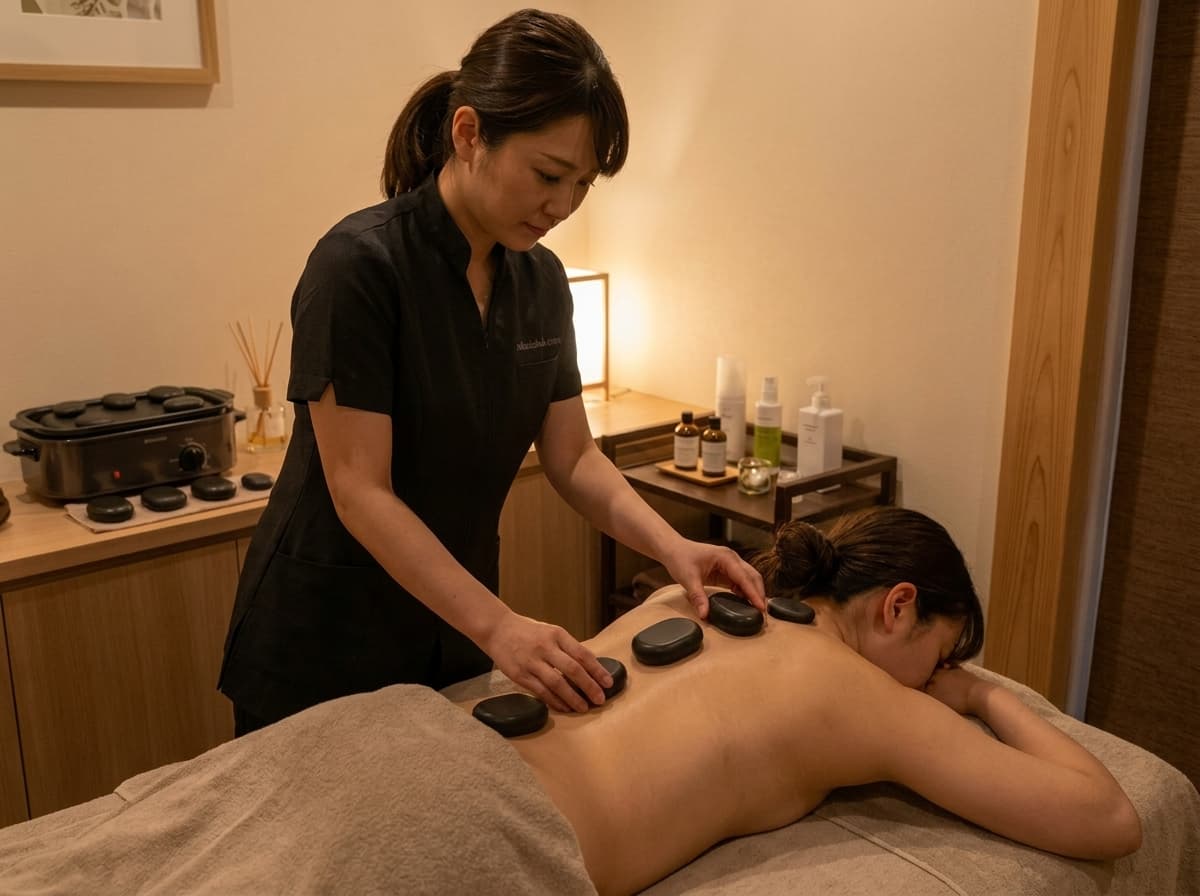
Effect
Benefits framed ethically inside restorative wellness—not medical guarantees.
Steady warmth invites gripping fibers to relent—welcome after chill exposure or nervous overload.
Many describe flushed openness across formerly stiff desk-bound zones.
Palms refine contours between placements so sessions avoid pure static immobilization.
Slippery carriers curb dragging friction while therapists steer stone pressure confidently.
Sustained warmth signals the nervous system toward rest—which is why clients commonly drift to sleep mid-session.
Warmed fascia stretches more readily, letting therapists reach deeper layers with less pressure than cold tissue demands.
Process
Cover meds, neuropathy, skin injuries, pregnancy, allergies to carriers, and no-go zones.
Stones rest or glide with checkpoints—feedback trims temperature before irritation spikes.
Heated stones glide over priority zones—broad strokes alternate with targeted static placements; the client reports sensation while the therapist adjusts heat and pressure in real time.
Rise slowly, hydrate, dodge icy drafts immediately post-session; dizziness warrants a seated pause.
Choosing the format
Three grounded intents stones satisfy exceptionally well.
If heating pads calm your lower back nightly, curated stones replicate studio-grade gentleness.
Ask technicians for expansive stones plus glide-heavy choreography—not relentless elbows-only stripping.
Book stones between heavy training blocks as maintenance—not when sharp new pain appears without evaluation.
Heat comforts—but honest disclosures reveal when it cannot.
FAQ
Rare yet possible—temperature mishaps plus neuropathy create hazards. Professionals towel-buffer hotspots and solicit continual verbal cues instead of endurance contests.
Swedish builds entirely on uninterrupted manual strokes; hot stone centers radiant heat as the primary relaxation catalyst, with hands filling in between warming cycles rather than leading throughout.
Some protocols intentionally alternate contrasts—but consent-first studios disclose upfront and skip chilling entirely upon request.
Maintenance sessions roughly every three to six weeks work well for most wellness clients absent conflicting diagnoses.
Verbally ask to remove the stone or reduce placements immediately. Pause therapy entirely if dizziness worsens or nausea appears.
Basalt is a fine-grained volcanic rock with high thermal mass—it absorbs heat evenly, holds it longer than most stones, and releases it gradually without temperature spikes. Polished surfaces glide smoothly through oil without abrading skin. These properties—not tradition alone—explain why basalt appears in NCBTMB-affiliated stone massage curricula worldwide.
That decision belongs to your obstetrician, not the studio. Most qualified therapists decline entirely in the first trimester when risk is highest. Second and third trimesters require individual OB sign-off: your doctor evaluates blood pressure, edema, venous health, and overall heat tolerance before clearing you. Some therapists decline at any stage—a well-reasoned position worth respecting.
Therapists
Practitioners across Ukraine who provide this massage type. Choose a specialist and view their profile.
Choose your city on the home page and browse profiles listing hot stone or heated stone massage.