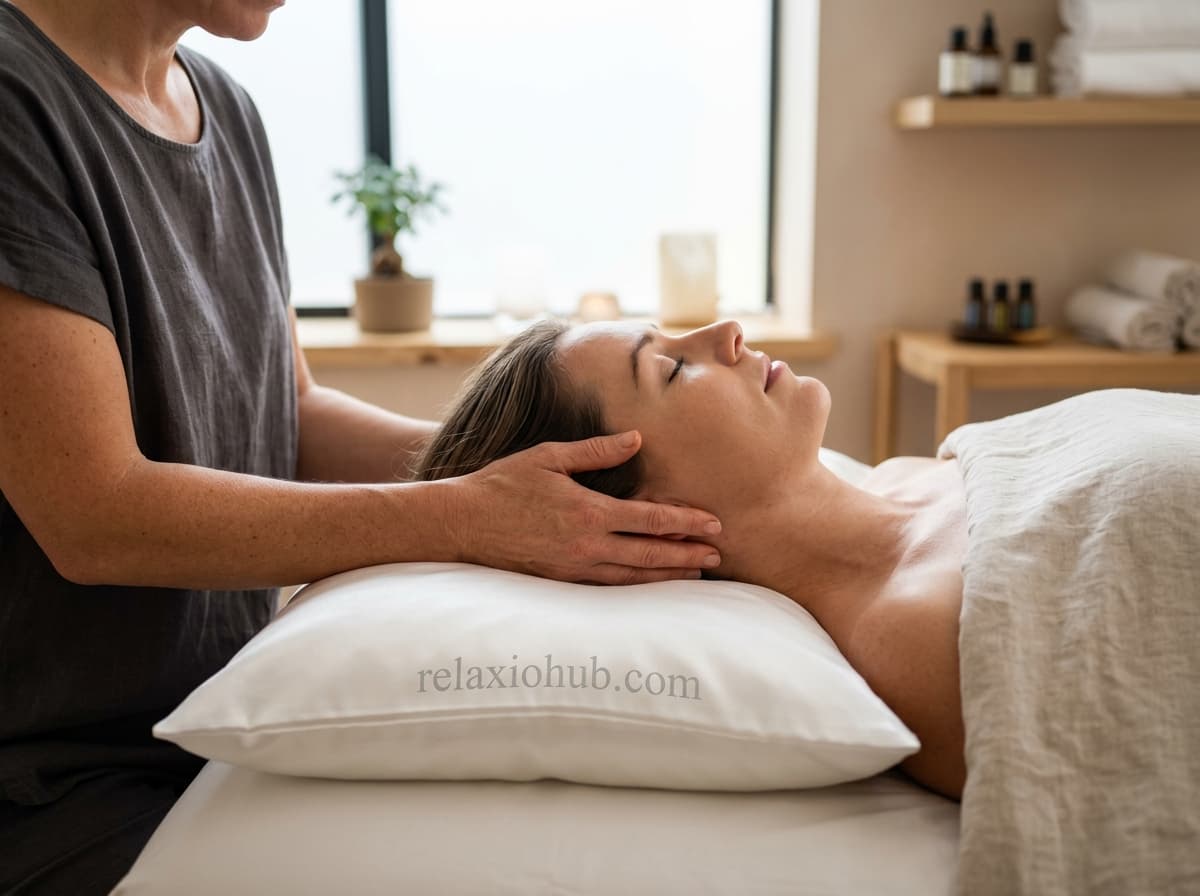
Stable contact under the occiput or along temporal lines
The hand does not press—it listens: you feel warmth and a faint CRI pulse beneath the occiput, with zero kneading or sudden movement.
In a salon setting this is almost always very gentle, small-amplitude contact: palms or fingertips rest under the occiput, along the sacrum, or across the rib basket longer than in classic effleurage, waiting on subtle shifts in tissue tone—without deep stripping of the neck or percussion on bone. Guests may register it as nervous-system downshift or as motion so quiet it demands patience; both are valid when marketing skips claims about fixing intracranial pressure from a table.
In the RelaxIOhub catalog
The term traces to William Sutherland's cranial osteopathy (1930s) and John Upledger, who in the 1970s systematized CranioSacral Therapy (CST) as a standalone modality. At its centre sits the CranioSacral Rhythm (CRI, 8-12 cycles/min)—a subtle motion of cerebrospinal fluid around the neural axis that practitioners learn to palpate through skull bones, the sacrum, and soft tissue. In wellness studios that abstraction becomes plain language: slow contact, extended listening stillness, attention to responses at skull, neck, diaphragmatic fascia, and sacrum, integrated through breathing. A transparent protocol states what will be palpated, how long pauses last, and what to do if dizziness or emotion surfaces.
Ethical marketing drops "moving cranial sutures" or "erasing migraines in one visit." Subjective ease in the neck, softer sleep, or less internal "noise" after stress happens for some clients; chronic pain, post-concussion syndromes, epilepsy, or suspected stroke belong to physicians and evidenced care. Versus a standard head-massage session, craniosacral formats emphasize minimal pressure, longer stillness, and fewer cosmetic strokes—though real-world offerings blur between cities and practitioners.
Sometimes "cranio" is marketed for pediatric behavior or developmental injury—those require full clinical teams, not a solo SPA hour. For adults, honest scope is supportive wellness, not diagnosing neurological conditions without a multidisciplinary team. For practitioners and educators: Upledger Institute's CST Level 1 trains CRI palpation, the 10-position protocol, and SomatoEmotional Release (SER)—skills that measurably refine hand sensitivity for any gentle bodywork practice.
Snapshot
Technique
School brands differ; your body notices whether "cranio" is marketing while hands sprint like classic scalp work.
The hand does not press—it listens: you feel warmth and a faint CRI pulse beneath the occiput, with zero kneading or sudden movement.
Support through a blanket or clothing is enough—sensation is a warm cradle at the base of the spine, never direct vertebral pressure.
Some guests notice breathing feels more spacious after rib-cage attention—no forced inhalation, just observation and room to expand.
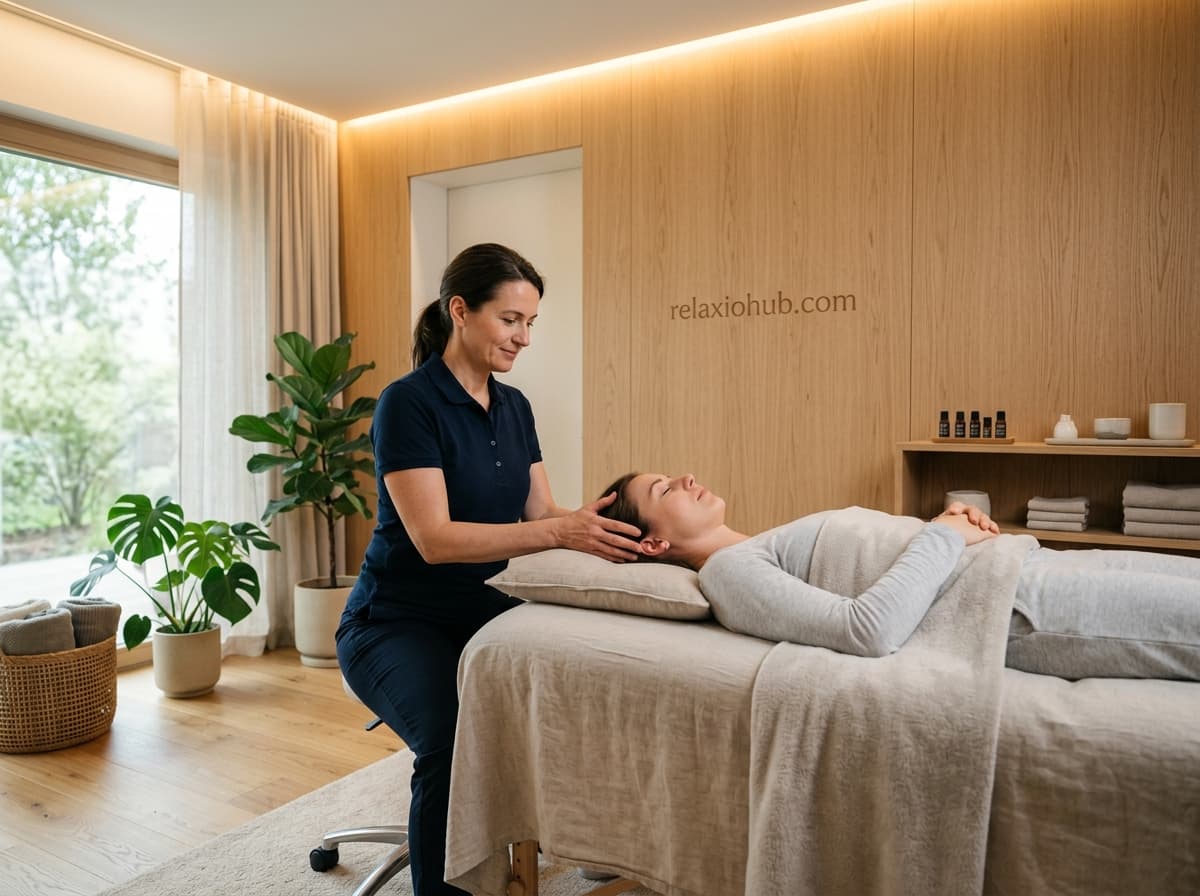
No cinematic yanks: the practitioner offers a new head position only to the angle where you are fully relaxed, then waits for tissue response.
The practitioner may facilitate a "still point"—a brief CRI deceleration: the autonomic nervous system uses this pause to step off high alert into steadier rhythm.
Why book
Nervous-system downshift and mindful touch—not a promise against migraine or anxiety as diagnoses.
Suits heightened skin and nervous sensitivity after burnout, stress, or chemical sensitivity.
Fewer sudden transitions means more chance for protective bracing to genuinely release rather than just shift location.
Helpful when you want more than trapezius work—a session that holds the body as a connected system from crown to tailbone.
Refusing acute neuro red flags signals clinical discipline—not a gap in the practitioner's "real cranio" credentials.
Some guests report breathing becomes roomier and more even during the session—a felt shift, not a delayed promise.
Head, neck, sacrum, and abdominal fascia addressed as one tensioned network—less common in standard massage formats that compartmentalize zones.
Flow
Neck opening is not abrupt after recent LOC or whiplash without context.
Practitioner names the pauses; you keep one word that stops everything.
Hydrate, skip violent head tilts for a minute; new vertigo deserves reporting—not silence.
Compare
Three intents—no mandatory winner.
Likely craniosacral or a salon-light interpretation of it.
Closer to our head-massage catalog page—combo possible if the therapist truly owns both tempos.
Myofascial or therapeutic formats usually spell that out—clarify goals before paying.
Light touch does not erase neurologic red flags.
FAQ
Adult sutures are fused in healthy bone; ethical SPA work should not promise bony reshaping. Practitioners address soft-tissue feel and autonomic tone—not bony clicks.
Less cosmetic scalp friction and more long stillness along the axis; if hands sprint like Swedish scalp work, ask which protocol you booked.
Not as a guaranteed fix. Tension components may ease for some; migraine with aura or thunderclap pain needs neurology and a personal plan.
No with proper pacing. Pain or nausea means stop and recalibrate depth—not endure.
Seek transparent training, acute-symptom refusal, and zero diagnostic palm claims; ask concussion experience before booking neck-focused work.
There is no universal protocol: some guests notice a shift after one or two visits, others keep a monthly maintenance rhythm. Be cautious of mandatory ten-session packages without stated, measurable goals—that is marketing logic, not clinical reasoning.
Price varies by session length and practitioner background: a 60-90 minute intake-plus-slow-phase session typically costs more than a standard head massage. Browse RelaxIOhub profiles for honest CST training descriptions and transparent scope of practice.
Therapists
Practitioners across Ukraine who provide this massage type. Choose a specialist and view their profile.
Compare profiles that spell out pacing, screening, and wellness boundaries—without promising diagnoses through touch alone.