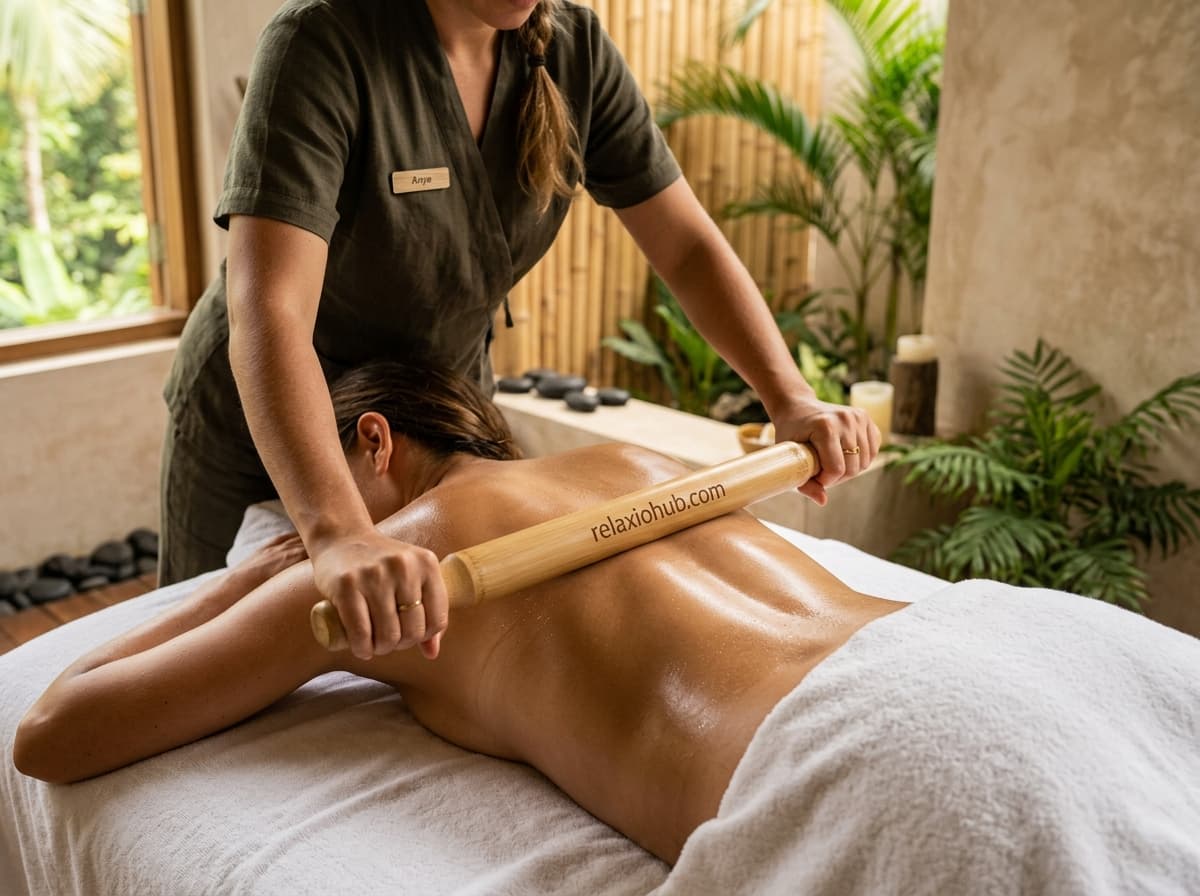
Narrow-rod rolling along paraspinals
The cylinder tracks smoothly—no jackhammer bounce—breath paces cadence.
Warm bamboo cylinders of different widths roll or press along tight lines while hands punctuate with oil glides—depth feels more structural than fluffy spa strokes yet should stay voice-led: if pressure races ahead of consent, the tool is being misused, and no session "proves toughness" by hiding pain.

Search intent
Searchers type "bamboo massage," "warm bamboo sticks," or "deep bamboo rolling" when they want heavier mechanical input without endless sharp elbows—or when hands-only sessions feel too uniform. Studios use cleaned bamboo rods of varied length/girth: skin is prepped with oil, heat (if any) stays in the cozy-to-warm band—never scald roulette—then sticks trace long strips, pivot slowly, or deliver brief static loads alongside palm effleurage so the glide never devolves into dry-drag abrasion.
Compared with manual deep tissue the geometry changes: load spreads along a cylinder instead of a knuckle island, vectors differ, and the story is adjacent—not a duplicate—of orthopedic elbow stripping. Compared with cupping or vacuum hoops, bamboo does not suction skin; compared with anti-cellulite myth marketing, no wood species magically liquefies adipose tissue without lifestyle context—treat miracle copy as a warning light.
Note: fair-skinned clients, blood thinners, or platelet issues may see redness or bruising—disclose before cash register. One booking never replaces clinicians for neuro lightning, fever, or fresh thrombosis concerns.
Snapshot
Technique
Branding differs—these are client-recognizable chips.
The cylinder tracks smoothly—no jackhammer bounce—breath paces cadence.
Wider stock spreads load so elbows need not hunt alone.
Localized presses assist release without making acupuncture claims.
Palms melt instrument edges and reduce single-spot trauma.
Gradual closure beats vanishing contact after heavy inputs.
Why book
No detox fairy tales—just altered mechanics of depth.
Cylinders spread force differently than knuckle peaks—sensation is novel, not automatically "better medicine."
Alternation lowers odd spots of repeated abrasion.
Thoughtful therapists ask about thinners, blood disorders, and fragile skin first.
Predictable oil-Swedish stacks get a timbered remix when done ethically.
Warmed sticks (50–65°C) raise local tissue temperature, promoting vasodilation and pliability before pressure loads — the same thermotherapy principle applied in physiotherapy.
A cylinder delivers mechanical stimulus along a different vector than soft tissue palms, engaging Pacinian and Ruffini mechanoreceptors less recruited by standard manual protocols — a sensory difference, not a hierarchy.
Flow
Osteoporosis with compression fear, blistering rashes, ASA/warfarin—say it before stick one.
Therapist demos tempo and reddening norms; you choose scale-up or plateau.
Hands seal the arc; hydrate, skip max squats on freshly hammered zones unless cleared.
The therapist reviews sensation in heavily worked areas, distinguishing expected muscle soreness from signs needing clinical follow-up: spreading haematoma, paraesthesias, or swelling beyond normal.
Compare options
Three honest forks.
Bamboo can deliver wide freight; pinpoint trigger hunting may still belong to narrower tools.
Hands-only or feather bamboo may be smarter—doctor green lights matter.
Massage may shift how skin feels short term; it is not a single-session adipose deletion protocol.
Pressure, heat, friction—classic guardrails.
FAQ
It can feel intense by choice—not mandatory. Sharp nerve zaps or sickening pain means pause, resize sticks, or stop.
Fair skin and blood thinners raise odds—discuss before depth scales up.
Cylinders change contact geometry and shear; choreography may echo deep work but somatic receipt differs.
Only with provider approval and a therapist trained in positioning—deep abdominal focus is generally out.
Look for stick sanitation notes, honest intake, red-flag refusal ethics, and zero toxin-melting slogans.
Bamboo's low thermal conductivity lets sticks hold moderate heat — typically 50–65°C surface temperature — for several minutes of movement without burning skin. The rigid cylinder focuses pressure along a predictable line while bamboo's micro-flexibility absorbs vibration. Compared to hardwood or metal, it balances heat retention with manageable weight.
A rod transmits force through a smaller cross-section than a palm or forearm, raising pressure per square centimetre. Fast rolling or small-diameter compression over superficial capillary beds increases microrupture risk. A clear verbal pain scale before and during work is the practical control mechanism for that risk, not a formality.
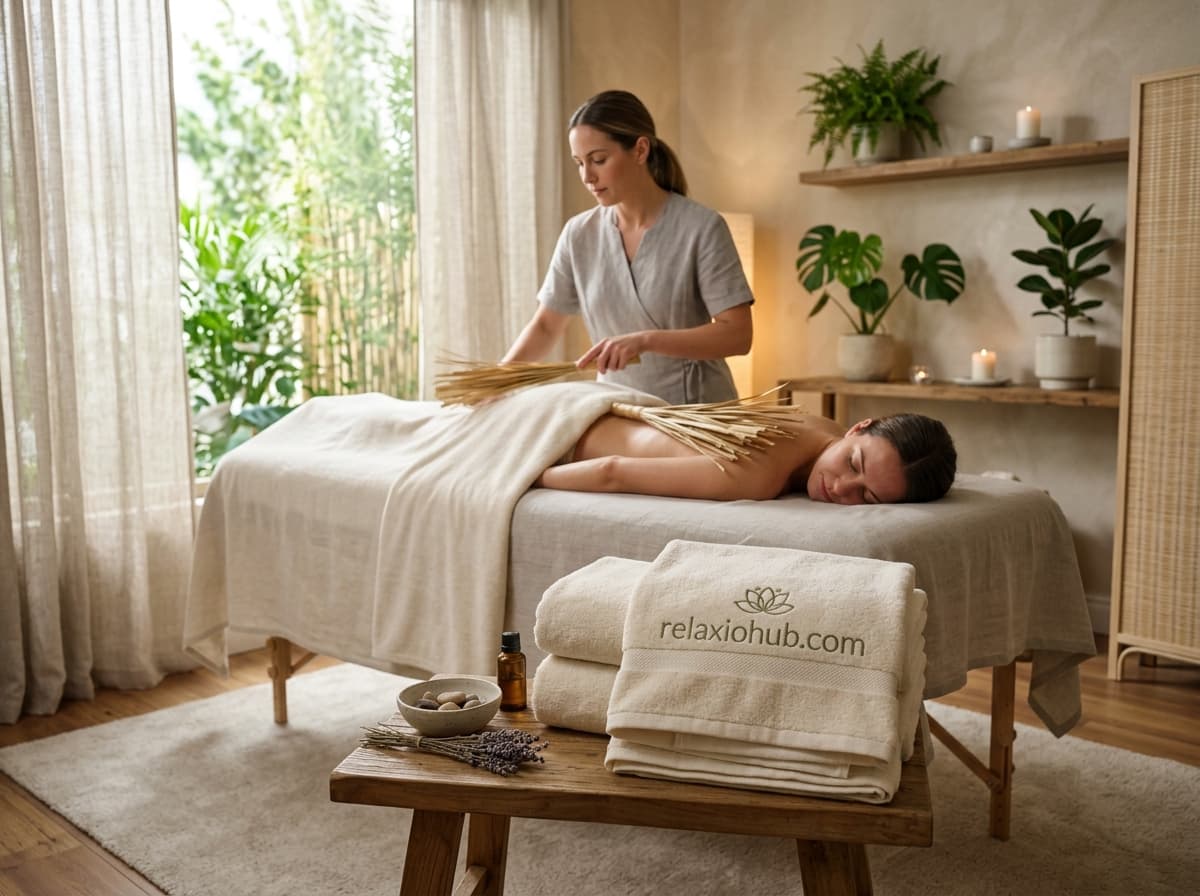
Radius and warmth sculpt pressure—your stoplight matters more than bravado about "harder bamboo."
Therapists
Practitioners across Ukraine who provide this massage type. Choose a specialist and view their profile.
Filter profiles describing warm bamboo protocols, tool hygiene, and respect for meds or easy bruising.