Mobility check
The practitioner asks about injuries, back, knees, hips, neck, yoga experience, and movements that feel unsafe or uncomfortable.
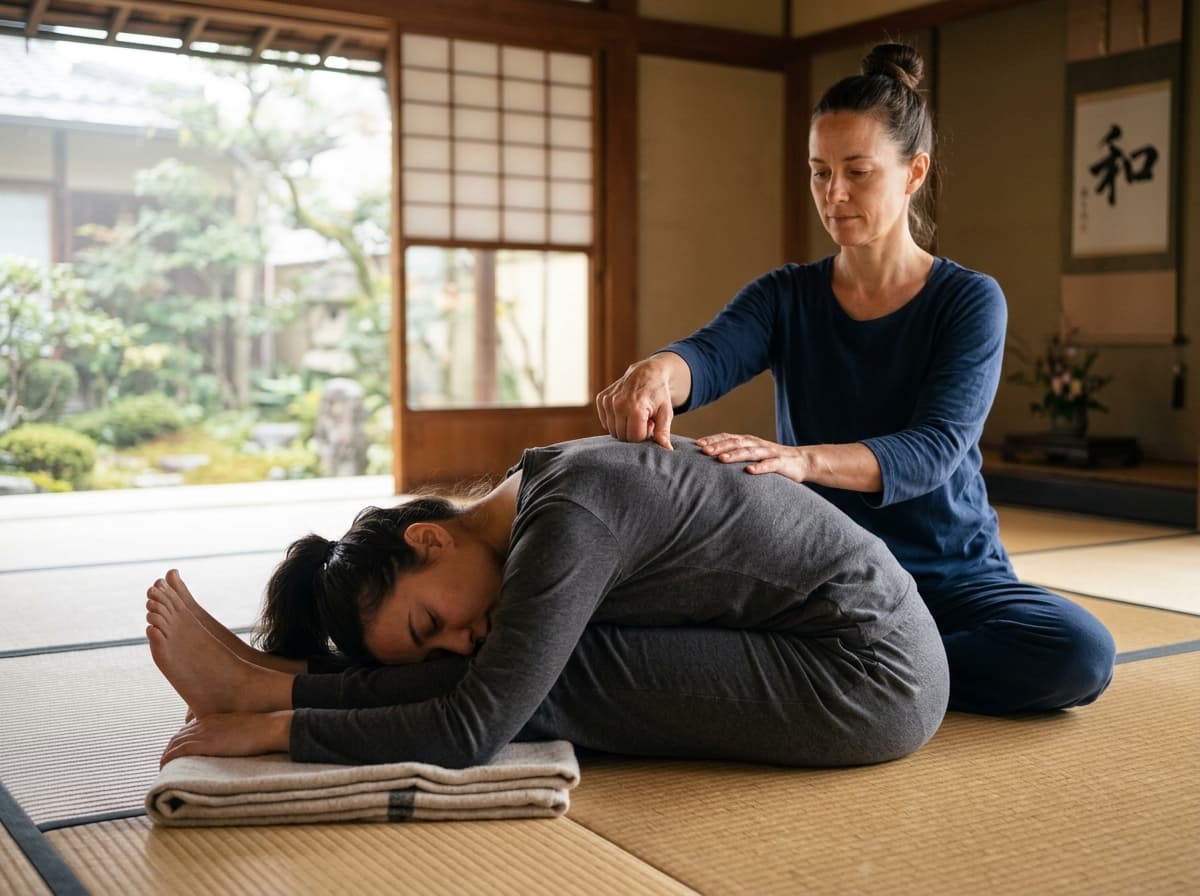
Asu Yoga massage looks at yoga through bodywork: the client lies or sits while the practitioner gently guides the body through passive stretches, supports, breathing pauses, and palm pressure so movement feels like massage, not a workout.
Yoga as bodywork
Asu Yoga massage sits between yoga, assisted stretching, and massage, with the practitioner doing most of the physical work. The client does not need to know asanas, hold balance, or use strength. The practitioner supports the limbs, rotates the torso, gently opens shoulders and hips, adds palm or forearm pressure, and constantly watches that stretching does not turn into a fight with the body.
Historically, this type of work did not grow from one single brand, but from several traditions: Indian yoga with asanas and pranayama, Thai yoga massage or Nuad Thai, Ayurvedic ideas of soft movement, and modern yoga therapy. In the 20th century, as yoga spread through Europe and the United States, demand appeared for a passive version: people wanted not a group mat class, but a personal session where the body is safely guided through movement.
Today yoga massage and passive yoga stretching are practiced most often in India, Thailand, Nepal, Sri Lanka, Bali in Indonesia, the United Kingdom, Germany, Poland, Czechia, Ukraine, the United States, Canada, Australia, and the UAE. Search demand often comes through phrases like “yoga massage,” “passive stretching,” “thai yoga massage,” “assisted stretching,” and “massage with yoga elements.” A useful page needs to make one thing clear: this is not a yoga lesson, but individual manual work with movement.
At a glance
Passive yoga bodywork
A good Asu Yoga session is not about putting someone into an impressive pose. It is about finding a comfortable range where tissues soften and breathing stays calm.
The practitioner asks about injuries, back, knees, hips, neck, yoga experience, and movements that feel unsafe or uncomfortable.
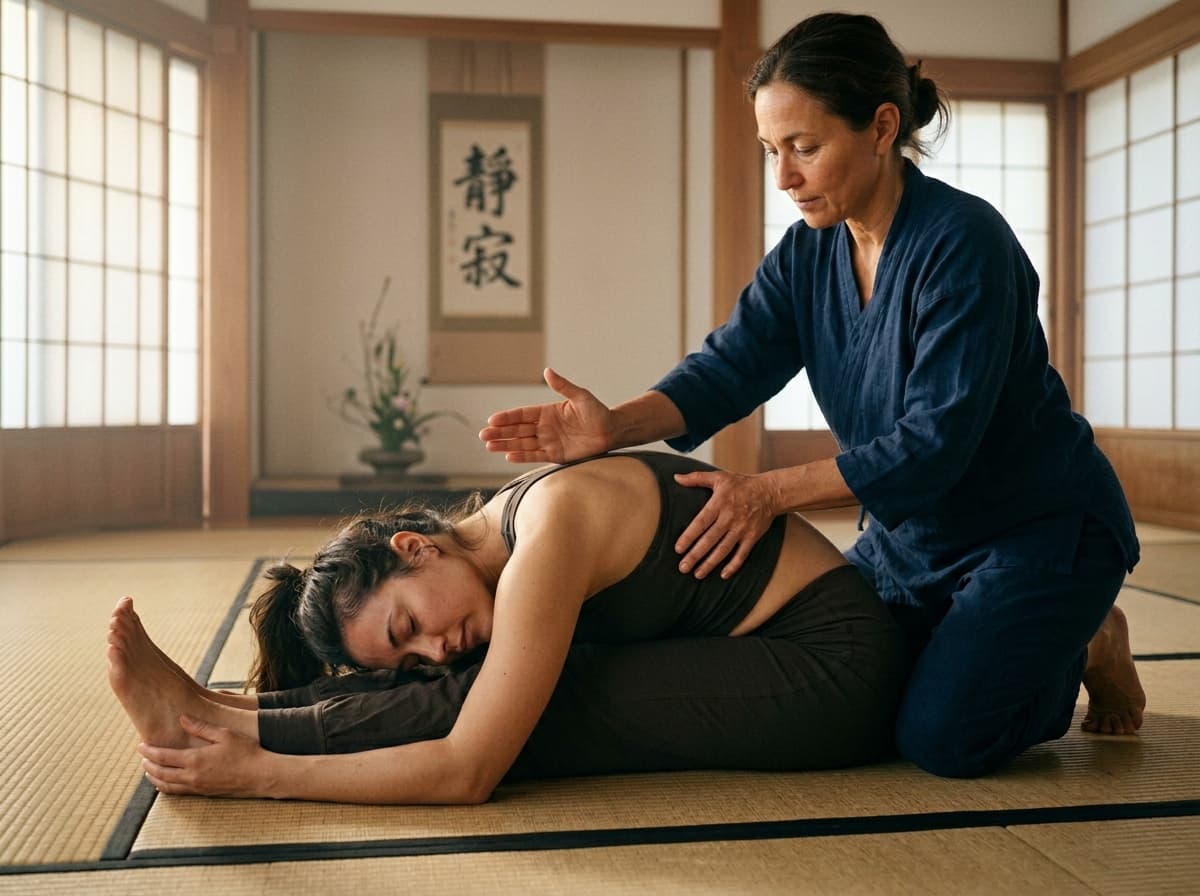
Arms, legs, or the torso are gently guided into length while the client stays relaxed and does not pull with force.
The practitioner supports a joint or pelvis so stretching moves through a controlled line rather than a random pull.
Between stretches, massage pressure may be added to the back, thighs, feet, or shoulders so the body reads the session as care, not sport.
Range may increase slightly on an exhale; if breathing becomes tense, the movement is brought back.
After each position, the body is slowly returned to neutral so no twisting or over-stretched feeling remains.
Expected effect
This format is best understood as movement-based massage for a sense of space in the body, not treatment for diagnoses or a replacement for rehabilitation.
Passive stretches can help you feel the shoulders, hips, back, and legs more clearly without doing the effort yourself.
Movement, pressure, and position changes create a feeling of activity, while the client does not work like in a yoga class.
The practitioner's hands, support, and pressure make the session personal and tactile, not just a sequence of stretches.
Movements are not rushed through force: the practitioner follows exhale, pauses, and a calm rhythm.
A skilled practitioner does not chase a deep pose at any cost and stops before sharp pain.
Experiencing passive guiding firsthand helps yoga teachers and therapists understand supported asanas, breathing cues, and assisted transitions from the client's perspective.
Timeline
You mention injuries, operations, back pain, hypermobility, pregnancy, disc issues, knees, shoulders, and comfort with stretching.
The practitioner starts with a small range to understand how the body responds to passive guidance.
Leg lengthening, shoulder opening, gentle twists, and work with feet, hips, or back alternate through the session.
Between positions, the practitioner adds pressure, rubbing, or holding so the nervous system has time to settle.
The session ends in a neutral position, with a few calm breathing cycles and no sudden jump up from the table or mat.
Comparison
These formats may look similar, but the practitioner's role and the client's experience differ.
Asu Yoga fits when you want yoga-based movement logic in a massage format with practitioner support.
Thai massage often has clearer pressure lines, mat-based work, and its own traditional sequence.
Assisted stretching in a fitness studio may feel more functional and less ritual-based than Asu Yoga massage.
Because this format uses stretching and passive positions, joints, spine, and nerve symptoms need special attention.
FAQ
It is a massage format with yoga elements: the practitioner passively guides the body through stretches, supports, soft asanas, palm pressure, and breathing pauses.
No. The client does not perform asanas alone. The practitioner supports the body and chooses a range that matches real mobility.
The format is linked to the broader history of Indian yoga, Thai yoga massage, Ayurvedic bodywork, and modern assisted stretching, which gradually moved into personal spa sessions.
It is often found in India, Thailand, Nepal, Sri Lanka, Bali, the United Kingdom, Germany, Poland, Czechia, Ukraine, the United States, Canada, Australia, and the UAE.
Thai massage has its own traditional system and often a clearer pressure rhythm. Asu Yoga may be softer, slower, and explained more through passive asanas.
No. The practitioner works within a comfortable range and follows your breathing. If any stretch feels sharp, say stop and the position changes immediately. Mild post-session muscle awareness is normal; acute pain is not.
Look for profiles that describe yoga or yoga-massage experience, stretching work, contraindications, range boundaries, and readiness to adapt positions to your body.
Compare profiles that describe passive stretching, yoga massage, breathing work, practitioner experience, contraindications, and softer options for beginners.