Clockwise circles around the navel
Slow loops teach the wall to trust incoming pressure.
Palms trace slow circles across the anterior abdominal wall while depth stays verbal and measured — giving the belly a sense of warmth and intentional contact rather than diagnostic pressure.
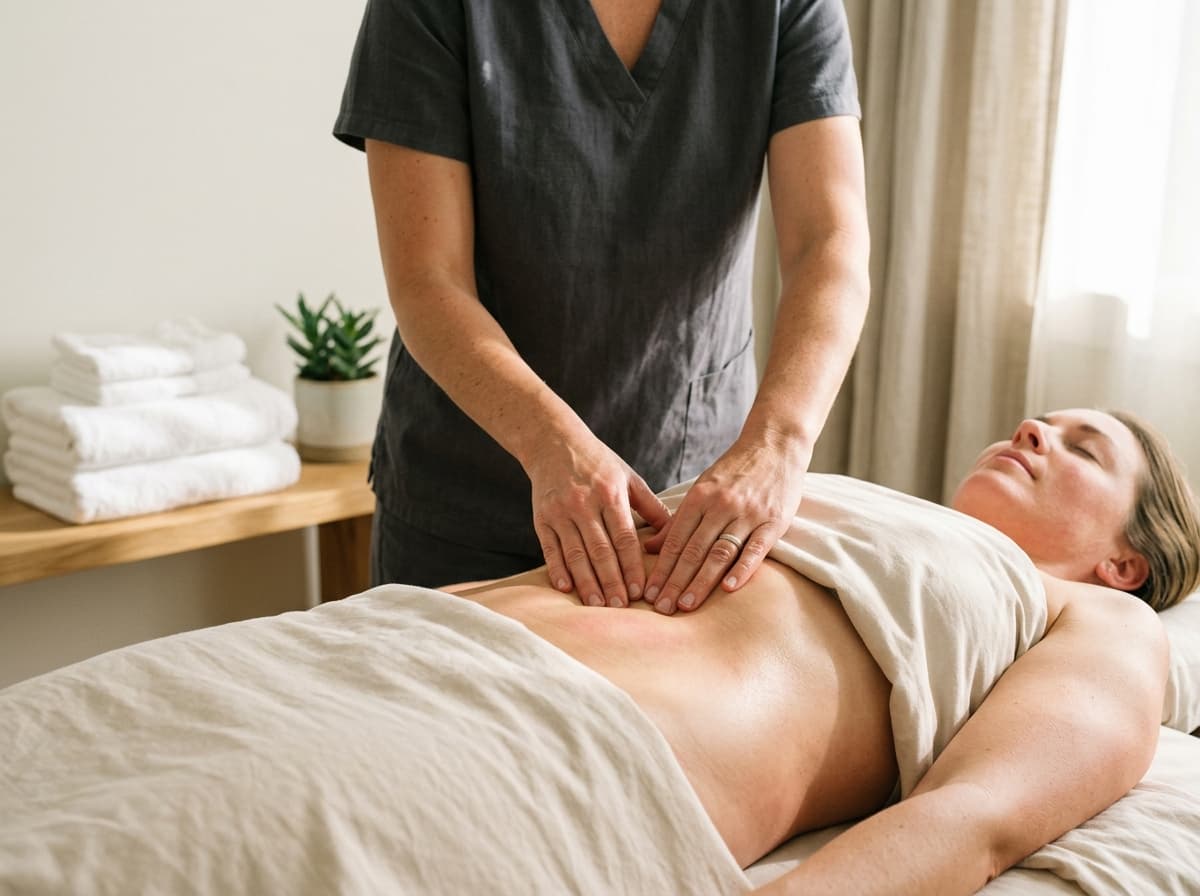
Midsection focus
Most formats carve out supine time with bolstered knees: superficial effleurage, clockwise and counter-clockwise loops around the umbilicus, then cautious kneading of rectus bundles—always flat-hand distribution rather than finger punching toward unknown deeper lumps. Professionals narrate depth changes and downgrade instantly if discomfort spikes.
This is wellness framing, not hospital visceral manipulation or imaging substitutes. Therapists must not promise to cure constipation, IBS, or "detox" organs without licensed oversight. Marketing that diagnoses through palpation alone deserves skepticism.
The anterior abdominal wall has four paired muscle layers: the rectus abdominis running vertically between the pubic symphysis and sternum, flanked by the external oblique, internal oblique and transversus abdominis whose fibres cross at angles to create a natural corset. Between the two rectus columns runs the linea alba, a fibrous midline seam that should never receive direct sharp pressure. Deeper, the large intestine follows a characteristic frame — ascending on the right, transverse across the middle, descending on the left — which is why competent abdominal massage follows clockwise circles: they trace the colon's natural direction. A practitioner who knows this anatomy lightens contact over the cecal junction, adapts to the client's breath cycle, and immediately stops if guarding suggests anything more than habitual tension.
Snapshot
Technique
Quality protocols prize flattening shear over surprise depth.
Slow loops teach the wall to trust incoming pressure.
Vectors respect fiber direction without violent cross friction midline.
Even load avoids pointy digit probing.
Exhales down-regulate protective guarding.
Withdraw contact gradually to skip startle reflexes.
Why book
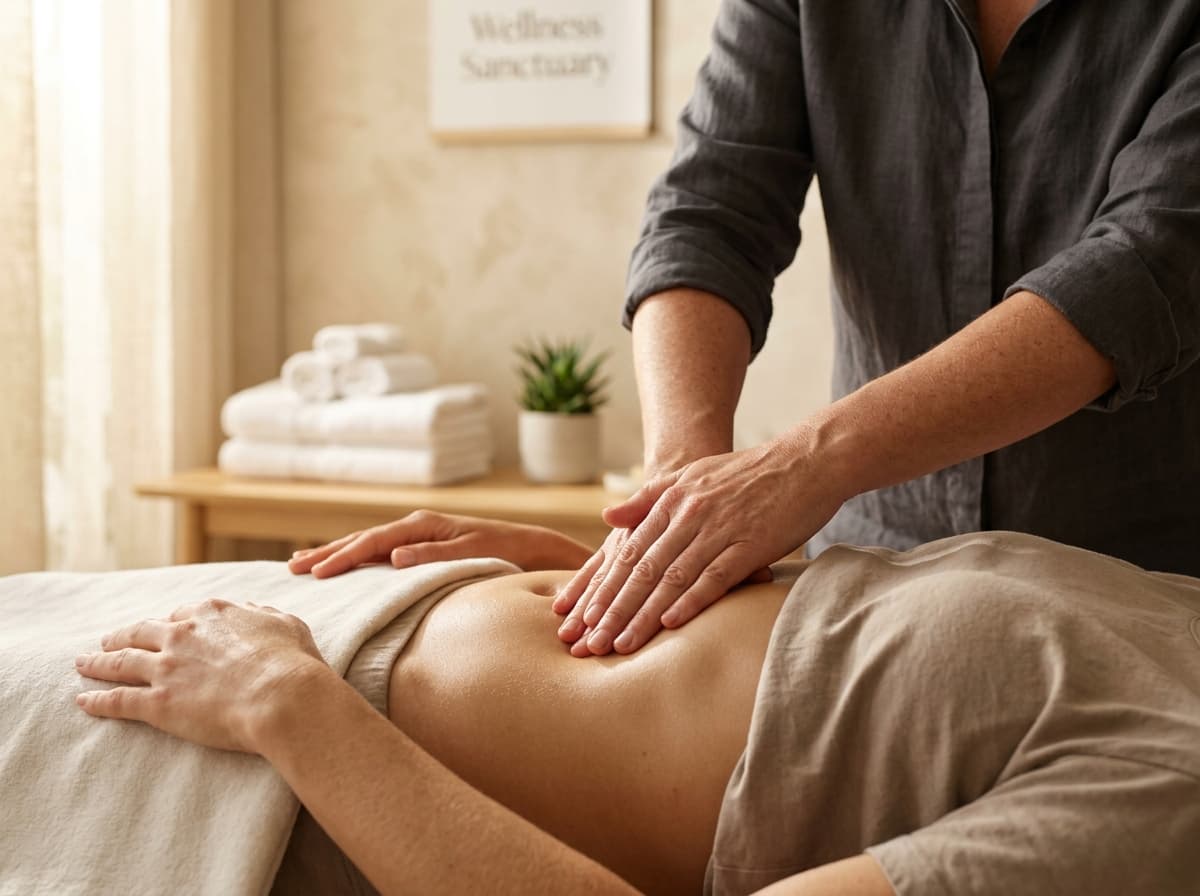
Slow belly work softens the defensive bracing that builds during desk hours, giving the anterior wall warmth and intentional contact — not a promised cure for IBS or constipation.
Slow tempo invites voluntary slack instead of reflexive bracing.
Some guests report less midsection heaviness post-stress—not equivalent to fixing obstruction.
You steer intensity aloud rather than enduring silently.
Letters or declines beat heroic depth after laparoscopy or cesarean births.
Flow
Fever, violent pain, melena, obstipation with zero gas—redirect to emergency care, not deeper strokes.
Knees and cervical angles settle before tempo climbs.
Therapists often marry belly work with gentle lumbar resets; table exits stay gradual.
Choosing the format
Three intents beside generic full-body passes.
Physicians rule out emergencies first; then studios provide tactile calm.
Dedicated timing buys transparency about boundaries.
Realistic expectations pair well; pathology hunts belong to gastroenterologists.
Suspicion beats stubborn booking optimism.
FAQ
No guaranteed GI outcomes—nutrition, meds, and specialists handle disease pathways.
Highly individual—many prefer ultra-light touch or skip entirely; autonomy wins.
Medical visceral modalities demand different training and scopes; SPA belly work stays superficial and non-diagnostic.
Only after healing milestones plus explicit clinician clearance; early weeks often mean refusal.
Roughly every 2–4 weeks within broader sessions unless doctors prescribe otherwise.
Initial contact is flat-palm warming — light and slow across the skin. Depth increases only as you exhale and only as fast as your comfort allows. Many guests notice warmth spreading outward from the navel, involuntary softening of the belly wall, and occasionally audible gut sounds — all normal responses to slow, measured pressure.
For habitual tension, yes: long sitting compresses the anterior wall and flattens the natural lumbar curve. Slow circles and kneading over the rectus and oblique lines can help the belly release defensive holding patterns. This is comfort care — it does not reverse postural load by itself or replace movement habits.
Therapists
Practitioners across Ukraine who provide this massage type. Choose a specialist and view their profile.
Ірина
Поліна
Василина
Оксана
Кіра
Ольга
Катерина
Iлона
Ivan
Сергій Олександрович
Тетяна
Віктор
Choose your city and vet profiles for stated belly-minute budgets, pain-stop policies, acute-symptom refusal ethics, and zero pseudo-medical guarantees.